


Ultra-flat MIDI keyboard with powerful synth engine: ESI XSynth
The very flat yet stable ESI XSynth MIDI keyboard comes with a synthesizer engine. Ideal for making music on the go.
(Image: heise medien)
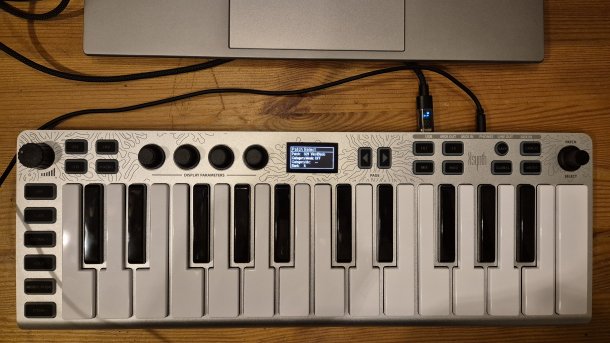
The ESI XSynth MIDI keyboard is very flat and small, comparable to the ultrabook device class for laptops, but for desktop keyboards. It also has a synth engine on board, making it ideal as a synthesizer for mobile use. The XSynth has 25 comparatively large keys (ESI calls them "full size") – but with a very short stroke of around 2 mm. They provide polyphonic aftertouch – which is also unusual in this device class. The aluminum housing remains light, but gives the device a high-quality and stable appearance. The device measures 39×14×2.7 cm and weighs around 650 grams. Despite its small size, all controls have sufficient space.
The XSynth combines state-of-the-art technology with intuitive operability. All you need is a power bank and a pair of headphones to start playing. In addition to the combined power switch and volume control, there are four endless encoders to the left of the OLED display on the XSynth's control panel. The manufacturer is quite proud of their shape, which flatters the user's fingers and is well-fitted. They sit firmly, nothing wobbles. A fifth knob is located on the far right and is used for patch selection. This is joined by a number of rubber-like buttons, some of which are also velocity-sensitive. These also jump in for pitch bend and mod wheel – unusual, but still unexpectedly easy to use. The display is easy to read and shows the parameters that can be adjusted with the rotary encoders. After a short time, the display changes to show the current waveform of the output signal.
Due to the design, the connections are also reduced in size. USB-C is used for power supply or connection to a PC or tablet, and also transmits MIDI or the audio data of the integrated audio interface. This delivers 24 bit at 96 kHz sample rate – which the synth also uses internally; the XSynth also digitizes the signal at the aux-in in the same way. There is also a 3.5 mm jack socket, which provides a MIDI input and output with TRS. The same socket format is available for headphones, line-out and aux-in.
Under the hood
ESI has taken over the Xkey MIDI controller series from the manufacturer CME, on which the XSynth is also based. It uses an ASIC, more specifically a custom DSP called RWA828. ESI did not provide any further details when we asked, but the IC can play many samples in parallel, which form the basis for the oscillators. The chip also has numerous audio inputs and outputs, handles USB, MIDI and more. It can therefore also be used directly as an audio interface – and even provide a synthesizer engine as a DSP. It is not possible to transfer your own samples to the XSynth, as the ASIC is already converting close to its limits.
Videos by heise
Synthesizer engine
The synthesizer engine implemented by ESI is described by the manufacturer as virtual-analog subtractive synthesis. It is based on three oscillators per voice. The oscillators are emulated by the samples – and the classic sine, sawtooth and square waveforms can also be easily reproduced. However, as with wavetable synthesis, they also enable more complex structures for interesting sounds. The engine can provide up to ten polyphonic voices.
The mod matrix with 16 slots makes it possible to directly influence the three oscillators or to map LFOs to filters such as the three AHDSR envelopes. The XSynth also provides three effect sections and an equalizer. This means that even simple oscillators can be used to create complex sounds and sound progressions. Some of the included presets – a total of 512, the XSynth records in four banks – include complete drum kit sample collections, so that the drum track can also be created directly from the device.
Played
The XSynth is ready to use straight out of the box. ESI provides its own ASIO driver for Windows on the XSynth download page. There is also the XSynth Editor for more complex settings of the XSynth with firmware 1.0, for macOS and Windows. This allows the firmware of the mini synthesizer to be updated to the latest version. ESI has not yet provided a changelog for the current firmware update.
Empfohlener redaktioneller Inhalt
Mit Ihrer Zustimmung wird hier ein externes Video (TargetVideo GmbH) geladen.
Ich bin damit einverstanden, dass mir externe Inhalte angezeigt werden. Damit können personenbezogene Daten an Drittplattformen (TargetVideo GmbH) übermittelt werden. Mehr dazu in unserer Datenschutzerklärung.
The XSynth can be used quickly and easily in a digital workstation (DAW) such as Studio One – either as a MIDI device, which interested parties have to create themselves, or directly via the audio interface. It takes just a few minutes to create and layer good-sounding tracks using the presets. The XSynth delivers a stereo signal. The built-in effects sound quite useful. Unlike the M-VAVE SMK-37 Pro, for example, nothing hitches, the ESI XSynth is fun to use straight away.
The flat keys with a short stroke may be a hurdle for experienced keyboard or piano players. For the occasional player, they work surprisingly and unexpectedly well. If you want, you can also switch off the internal synthesizer in the settings. The XSynth then runs purely as a MIDI keyboard.
The ESI XSynth was announced some time ago. It has actually been available since around the end of July. It currently costs 369 euros at all the usual musical instrument retailers.


(dmk)


