


Apple invests another 100 billion in domestic production and supply chain
New “American Manufacturing Program” is intended to boost domestic production. Apple's declaration of intent is a reaction to Trump's threat of higher tariffs.
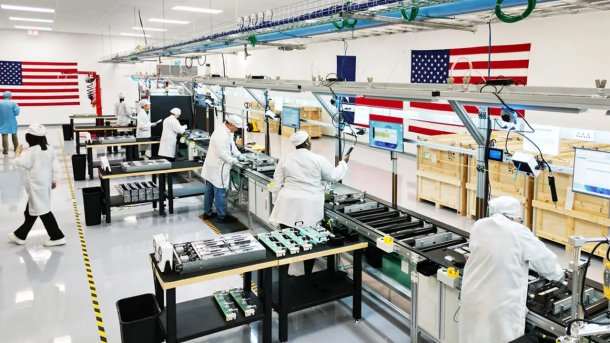
Apple's server production in Houston
(Image: Apple)
Apple has announced that it will invest a further 100 billion US dollars in its domestic production and supply chain over the next four years. The group is thus increasing the investment program introduced in February of this year to 600 billion dollars. The beneficiaries are ten American suppliers, such as glass manufacturer Corning. Apple's declaration of intent is apparently due to pressure from Donald Trump, as the US President is planning higher tariffs for the import of chips and semiconductors. There are only exceptions for companies that produce in the USA.
Just under six months ago, the iPhone company said that Apple wanted to invest 500 billion dollars in the USA. This is intended to create 20,000 new jobs in the country over the next four years. However, the investments were not linked to any iPhone factories that Trump would like to see in the USA. Some investments have already been announced in recent years, while other projects involve the expansion of existing facilities. The plan for a server production plant in the US state of Texas with thousands of new jobs, which is due to start operations in 2026, was new.
American Manufacturing Program with 10 partners
The recently announced expansion of this investment program with the new “American Manufacturing Program” (AMP) gives a similar impression, making it unclear what is actually being created and what is merely being expanded. Apple emphasizes the close cooperation with suppliers such as Corning, Coherent, GlobalWafers America (GWA), Applied Materials, Texas Instruments (TI), Samsung, GlobalFoundries, Amkor, and Broadcom. These will be the first AMP partners. Apple is also supporting domestic production by purchasing US magnets worth half a billion dollars from MP Materials. The company announced this around three weeks ago.
Videos by heise
Apple particularly emphasizes the 2.5 billion dollar investment in Corning, which is part of this 600 billion program. Corning already supplied the screen glass for the first iPhone in 2007 and will be able to expand its workforce at a factory in the US state of Kentucky by 50 percent thanks to the new Apple investment. This means that all iPhones and Apple Watches will be equipped with glass produced in the USA for the first time, not just the units sold in North America.
These investments will strengthen the supply chain, especially within the USA, but Apple has not yet committed to domestic iPhone production, which Trump has repeatedly emphasized. Currently, iPhones sold in the US are mainly manufactured in India, company CEO Tim Cook recently explained, while MacBooks, iPads, and Apple Watches for the US market are produced in Vietnam, according to Bloomberg.
iPhone production and customs duties
“We are obviously trying to optimize our supply chain,” Cook said. “And ultimately we will do more in the United States.” However, the Apple boss evaded specific questions about relocating iPhone production to the USA. Trump has apparently also now realized that it is difficult to simply relocate the mass production currently carried out by hundreds of thousands of employees in India and China.
“I don't know when it's going to be, but there are many factories and plants that are either under construction or starting construction soon,” Trump said yesterday, according to NBC News. “So I can't tell you exactly when, but I'd like to be there in about a year or two, because I think we're going to see an explosion.”

From Thursday, the US will impose some new country-specific tariffs. This also affects India after they recently bought Russian oil. Imports from India were previously subject to a 25 percent tariff, but Trump is increasing this by a further 25 percent today. So far, the punitive tariff effect has been small and has had less of an impact on Apple's figures than feared. Most recently, the additional costs were 800 million dollars instead of 900 million dollars, but things are set to get worse in the third quarter: A whopping 1.1 billion dollars have been budgeted for customs and trade effects.


(fds)

