


GPT-5: OpenAI publishes new language model for ChatGPT
The new GPT-5 is supposed to program better and answer technical questions with fewer hallucinations. US companies are already using it in high-risk areas.
(Image: OpenAI)
OpenAI is releasing its new language model GPT-5 on Thursday evening. The new model is said to respond more reliably and hallucinate less than its predecessors. It can also answer technical questions at expert level, the company explains. Examples cited by OpenAI include tasks in risk areas such as finance and healthcare.
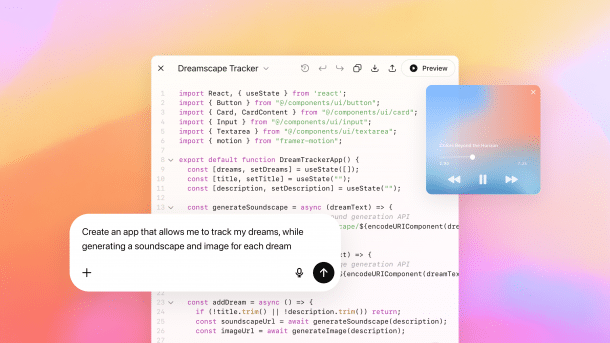
During a video call for the press, OpenAI employees demonstrated some capabilities of the new model. For example, they had it program a web app on a prompt. If you entered the same prompt several times, a different app with a different user interface came out each time.
Consolidation
While with GPT-4 you had to choose between different model variants depending on the task, GPT-5 combines everything under one hood. ChatGPT grants customers access to GPT5-5, including the reasoning functions, without a paid subscription. However, the number of questions that can be asked of the model is limited. The Plus subscription for 23 euros per month grants a significantly higher quota. Pro users, who pay ten times as much per month, can ask the model any number of questions and, according to OpenAI, have exclusive access to a Pro version of GPT-5. There will also be slimmed-down versions called mini and nano, which provide faster and cheaper answers.
OpenAI specifies the context window as 256,000 tokens. Users who need to process longer texts with up to one million tokens can continue to use GPT-4.1. With two new parameters called "reasoning" and "verbosity", developers can control how thoroughly GPT-5 ponders its answers and how detailed the model responds. This can be used to limit the scope, time required and price of the expenses that are billed per token when using the API. The prices are 1.25 US dollars for one million input tokens and 10 US dollars for one million output tokens. By comparison, the European provider Mistral charges just USD 6 for one million tokens of its largest model, while the Chinese provider Deepseek charges just USD 2.19 for R1.
In the answers, GPT-5 should be less chummy than GPT-4 and answer topics that exclude the content filters within the scope of what is permitted. According to OpenAI, an external service provider would have tested the model for security problems for 5,000 hours (Red Teaming) –, a figure that seems low given the complexity of a language model.
Videos by heise
Use in high-risk areas
Various US companies have apparently been given advance access to GPT-5, with OpenAI reporting that the private health insurance company Oscar Health is already checking applications from its policyholders using GPT-5. The transportation company Uber uses GPT-5 for customer support. GitLab, Windsurf and Cursor use GPT-5 for software development and the Spanish bank BBVA is already using the new model for its financial analyses. OpenAI also listed biotechnology company Amgen, retailer Lowe's and software developer Notion as other companies using GPT-5 before its release.
It is notable that these companies appear to be using a brand new, previously unpublished and untested model, including in critical areas such as healthcare and finance, for which no independent evaluation is yet available. According to OpenAI, GPT-5 is designed to identify potential health problems, ask questions and include the user's location in its responses. In Europe, such use would be problematic for data protection reasons alone if companies were to share customer data with OpenAI. This is because, unlike the recently introduced open-weight variants of GPT-4, GPT-5 only runs on OpenAI's servers. Caution is also advised when connecting GPT-5 to Google accounts, including GMail, contacts and calendar, as intended by OpenAI.
In a promotional statement, Michael Turell, head of the programming editor Cursor, praised the new language model: it can even detect deeply hidden bugs in code. In a study previously published by the non-profit organization Model Evaluation & Threat Research (METR), it was found that programmers worked 20 percent slower when coding with Cursor and the LLMs Claude 3.5 and 3.7 Sonnet. More than half of the code generated by the Anthropic models was unusable. We will have to wait for independent studies to see whether GPT-5 actually delivers better results here.
OpenAI did not disclose any basic information in advance, such as the model size, training effort and energy requirements of GPT-5. Questions will be answered shortly in a livestream on GPT-5 and a developer blog, including the GPT-5 model card.


(hag)


