


Public transport: Why German conditions are not "normal"
Public transport passengers in Germany are used to a lot of suffering. What is not normal is normal here. A look abroad also shows this.
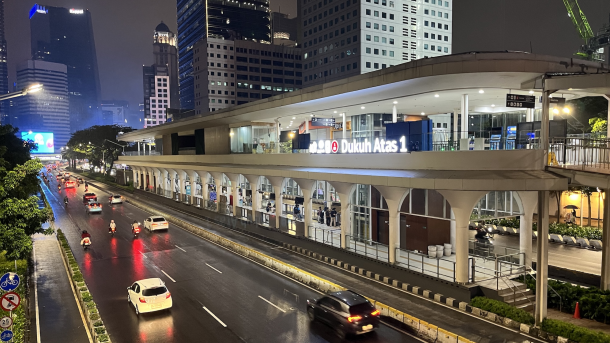
Some Transjakarta BRT bus stops operate with platform screen doors, but are often open.
(Image: Andreas Sebayang)
When it comes to buses and trains, things are not looking good in Germany at the moment. The systems are breaking down in many cities. Sometimes there are more breakdowns, sometimes fewer. But the trend is clear: things are not getting better and there is no end in sight. And it's not just local public transport but also long-distance transport, which many people now also use to commute.
We are going to Berlin
The failures and unreliability are manifold. In Berlin, for example, the BVG subway and Deutsche Bahn's S-Bahn are struggling with numerous breakdowns. The enormous effects of the cost-cutting measures of the last few decades are evident in the U-Bahn. Hardly any new vehicles have been ordered. New JK series subway trains will only be put into passenger service this year.
The old subway trains will probably not last much longer. They are in such a poor condition that there are frequent breakdowns. As a passenger, you notice this above all in the door malfunctions. A red light or a sticker indicates that the door is not working. This is a problem that you hardly ever see in other countries.
Door malfunctions? Almost non-existent elsewhere.
In South East Asia, for example. Here, so-called "platform screen doors" are often used on the platform. This means that two pairs of doors must always work very reliably. However, even in Europe or the USA, failing doors are almost impossible to detect – including countries that increasingly use platform protection. Doors in rail vehicles are highly reliable hardware.
Even countries that generally use old rolling stock do not seem to have a issue with the sets. In Japan, many old trains run around in a well-kept condition. Poland's and the Czech Republic's streetcars are a veritable zoo of series from different generations. In North Korea, the so-called steel Doras (BVG series D) from Berlin are still on the rails today.
Material that old is maintenance-intensive. And in Germany, on the other hand, people like to save a lot of money. It would therefore hardly be conceivable to use them in Berlin, as the workshops are now also suffering from a homemade shortage of staff. When the workshops are at capacity, the worst that can happen is that rush-hour trains are shortened. If this is compounded by a shortage of drivers, then only every third or fourth train will run.

(Image: Andreas Sebayang)
Staffing levels are so low that the U4 subway line can only run 25% of its services during rush hour. At least the trains will be twice as long. The U1 subway line is sometimes even shortened to three stations instead of running to Kreuzberg. All this makes for fuller trains and greater sensitivity to delays, which trigger subsequent delays.
Digital information systems fail
If the situation is this bad, then flawless communication is actually essential for passengers. However, there is a considerable shortfall here in Germany and Berlin is a prime example of how not to do it. This is because the systems are actually designed for reliable local transportation. Only in exceptional cases should they report disruptions and provide information.
In Berlin, this is a manual process. If a train breaks down, someone has to manually remove it from the digital information systems. It often happens: two trains are supposed to leave the platform in the same direction at the same time. However, two trains do not arrive coupled together. Instead, the trains are virtually jammed.
This got so bad at times that in September 2024, after much criticism, BVG set up a temporary workstation to clean up the passenger information that was only traveling virtually through the network in the real-time system. It will then be deleted. Apps or map services with real-time information will also benefit from this, as the virtual trains will also disappear.
Local transport at the limit
The problem of digital displays can also be seen at Deutsche Bahn throughout Germany. Anyone who is familiar with track layouts, train timetables and train intervals is sometimes surprised at the garbage shown on the displays. In the event of disruptions, the situation looks very bad. At some stations, this is compounded by the combination of local and long-distance services.
In the event of major disruptions, the displays quickly become useless. In mid-July, for example, there was an overhead line fault in Frankfurt (Main) Süd. Frankfurt South is – already at its capacity limit due to construction work in the Offenbach S-Bahn tunnel –. However, when an overhead line fault occurred towards the evening of July 15, almost the entire display system collapsed and the DB Navigator was largely useless. There were also no announcements that could have explained the situation.
You could see in real time that the staff there were under an extreme workload. They were allowed to suffer the failings of politicians and Deutsche Bahn and at the same time were exposed to the wrath of the passengers without protection. The only thing that worked reasonably well in Frankfurt that day was the S-Bahn service from the terminus station and the separate S-Bahn infrastructure in the underground station.
There are even no regular announcements about the many timetable changes. Deutsche Bahn refers to the apps and notices, as the company informed us. This is particularly problematic when traveling to the airport. For tourists and business people, the apps and timetable changes are a major challenge. For example, the modified timetable for Bonn Hbf from August 3, 2025 has 30 pages, the regular one has 25.
Visitors arriving or departing from Frankfurt am Main on connections with the many South Korean companies, for example, are not used to unreliable airport connections. They lack the training for Deutsche Bahn. They also don't know that, due to construction work, airport S-Bahn trains can sometimes depart from tracks 103 (S9, bottom) and 21 (S8, top) at intervals of three minutes.


