


Astronomy: "The star furthest away from us" may not be a star at all
Three and a half years ago, the most distant star by far was discovered. However, it may not be a single object at all.
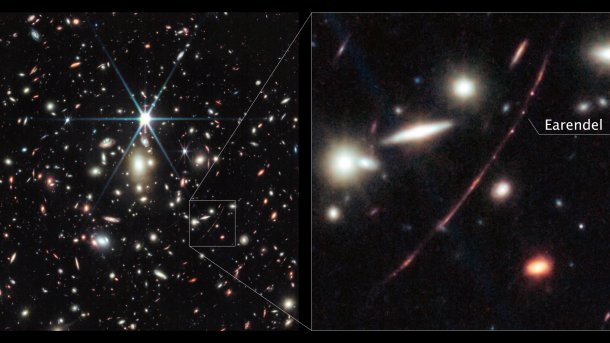
The image of the James Webb Space Telescope from Earendel
(Image: NASA, ESA, CSA / Dan Coe (STScI/AURA for ESA, JHU), Brian Welch (NASA-GSFC, UMD) / Zolt G. Levay)
The astronomical object "Earendel," which is currently by far the most distant star known to us, could also be a star cluster. This is the result of a recently published research paper in which the light of the object was analyzed anew. According to the responsible research team from the University of California, the spectroscopic data fits very well with such a dense collection of stars; this star cluster would therefore be between 30 and 150 million years old. In addition, Earendel would look exactly as we imagine star clusters that have already been researched in this epoch of the cosmos, study author Massimo Pascale told Live Science.
The light took 12.9 billion years to reach us
Earendel was discovered more than three years ago with the Hubble Space Telescope; we can see the object less than a billion years after the Big Bang. This was possible thanks to a particularly fortunate circumstance: an immense cluster of galaxies between us and the distant galaxy of Earendel bends and focuses the light of the object in such a way that it is enormously magnified for a limited period of time. It was assumed that it was a massive main sequence star of spectral class B, which is about twice as hot as the sun and more than a million times as bright. This gave Pascale the idea to test the theory that it could be a collection of stars, he explained to Live Science.
Videos by heise
Even though the spectroscopic data from Earendel now fits well with a star cluster, this does not mean that the question about the nature of the object has been answered. An astronomer from the team that discovered it has now pointed out to the science magazine that Pascale's group has not examined any alternative explanations. Not all conceivable scenarios were examined and the results compared. Both astronomers agree that only further observations with the James Webb space telescope can clarify whether Earendel is by far the most distant star or not. The new analysis has been published in the Astrophysical Journal Letters.



(mho)

