


Particles behind dark matter? With a trick probably found trace of axions
Axions have so far only been hypothetical elementary particles that could form dark matter. With a trick, a trace may now have been found for the first time.
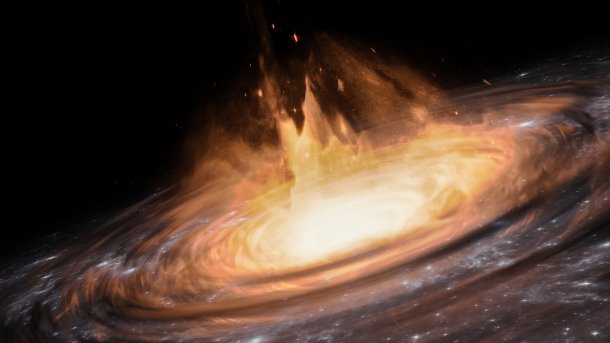
Artistic representation of a supermassive black hole
(Image: MattL_Images/Shutterstock.com)
A research group from Denmark has harnessed the extremely strong magnetic fields of gigantic galaxy clusters to search for as yet hypothetical particles that could make up the mysterious dark matter. The University of Copenhagen has now made this public and explained that the research team uses the galaxy clusters as a kind of enormous particle accelerator and also combines the measurements. Only by combining the measurement data from a total of 32 cosmic objects have they discovered “a pattern that corresponds to the signature of the elusive axion particles,” the team writes. Although this is not proof of the existence of axions, it is an important milestone.
“A kind of cosmic whisper”
As the group explains, for the analysis they looked for traces of gamma rays that originate from supermassive black holes and pass through the gigantic magnetic fields of galaxy clusters. According to the theories, this radiation can be partially converted into axions, and this transformation leaves behind “small, random fluctuations” in the measurement data from there. However, these signals from individual galaxy clusters are so weak that they are lost in the noise. It was assumed that the signals could be made visible by combining several sources. This is exactly what was achieved, and a kind of step was made visible in the measurement data that could show the origin of the axions.
Videos by heise
Although this is only an indication of a possible discovery, the result is “very tantalizing and exciting”: “You could describe it as a kind of cosmic whisper that is now loud enough to hear,” says Oleg Ruchayskiy from the university's Niels Bohr Institute. His team is convinced that the possible discovery brings us one step closer to understanding the mysterious dark matter. They have also learned significantly more about axions and can now draw an initial map showing their occurrence. Other teams could also copy the procedure and repeat it for other areas of the electromagnetic spectrum. The work has been published in the journal Nature Astronomy.
The question of the nature of dark matter is currently one of the most important in fundamental physics. It was postulated that it must exist based on astronomical observations in which stellar movements were measured that could not be adequately explained by known matter and its gravity. In total, there should therefore be five times more dark matter in the cosmos than classical matter. Even more is accounted for by the no less mysterious dark energy. It could consist of axions, and the search for these particles is being conducted in very different ways. At the German Electron Synchrotron (DESY) in Hamburg, for example, the “light-through-the-wall experiment” ALPS II is being conducted with precisely this goal in mind.



(mho)

