


Tabletop strategy in virtual reality: "Grit and Valor – 1949 VR" tried out
Strategy fans can look forward to miniature battles with mechs in "Grit and Valor – 1949 VR", but must be prepared for imprecise controls.
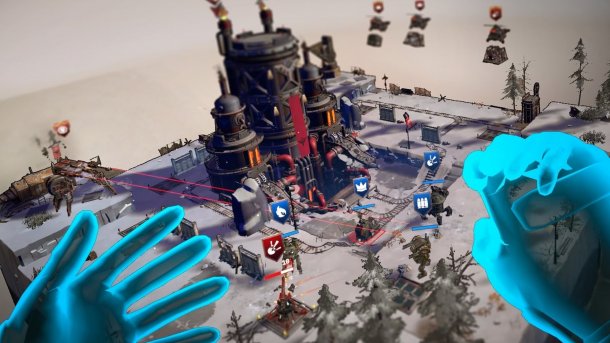
"Grit and Valor - 1949 VR" appeals primarily to tactics and roguelite fans.
(Image: nDreams)
With “Grit and Valor—1949 VR,” developer studios Milky Tea and nDreams are bringing a mix of real-time strategy and roguelite elements to virtual reality. Our first hours of play on Meta Quest 3 show that anyone who enjoys tactical thinking and miniature aesthetics will get a well-thought-out, albeit not fully developed VR experience.
Grit and Valor - 1949 VR (4 Bilder)

heise online / joe
)Diorama instead of world map
The action takes place in a fictitious year 1949, in which Europe continues to suffer under the influence of the Axis powers. The war has shifted to a phase of machine domination: giant combat robots patrol destroyed cities, while a small resistance fights for every piece of ground. Players take control of a special unit that launches attack after attack against the superior forces.
The missions in virtual reality start on a virtual table that is set up like a miniature battlefield. This is divided into square sectors on which the units can be placed. Resourceful commanders immediately notice strategically important points such as bottlenecks, places to retreat to for cover, or higher levels for more efficient firing.
As soon as a figure has reached its objective, it acts largely independently. We simply set the direction and decide when to trigger which special ability. The aim is to survive several waves of attacking enemies while simultaneously completing secondary tasks, such as securing certain buildings or disabling enemy jammers.
Roguelite structure with pressure
Losses are part of the game concept: if a mission fails, the level layout changes on the next attempt. Thanks to new enemy combinations and alternative rewards, setbacks don't feel like a waste of time. The troops can also be continuously improved in the base between missions: new weapon modules, stronger armor, or additional abilities for the mech pilots noticeably change the balance of power in the upcoming battles.
Good resource management is crucial in the very first missions. If you don't specifically collect supplies in the field or make use of air support bonuses, you run the risk of being overrun in the later waves. Choosing the right mech-pilot combination is also crucial, as each character has its strengths.
Empfohlener redaktioneller Inhalt
Mit Ihrer Zustimmung wird hier ein externes YouTube-Video (Google Ireland Limited) geladen.
Ich bin damit einverstanden, dass mir externe Inhalte angezeigt werden. Damit können personenbezogene Daten an Drittplattformen (Google Ireland Limited) übermittelt werden. Mehr dazu in unserer Datenschutzerklärung.
Miniature battles with hand-to-hand contact
Meta Quest 3 can be controlled using controllers or hand tracking. In both cases, however, operation is not always precise: it is often not immediately possible to correctly grab the desired figure or drag it to the intended square. This lack of precision is particularly annoying in hectic situations, for example, when units need to be repositioned quickly to secure a flank.
Switching between movement and selection mode also occasionally hitches. Although the battlefield can be freely rotated, tilted, and zoomed, which helps to maintain an overview, if elementary commands are not accepted reliably, you quickly lose control of the action.
Videos by heise
Stylish battlefield with diesel punk flair
“Grit and Valor – 1949 VR” has a striking tabletop look. The dioramas look like lovingly built miniature worlds with small details and a harmonious diesel punk atmosphere. Explosions, radio transmissions, and mechanical noises create a suitable soundscape without impairing concentration. Unfortunately, technical weaknesses such as edge flickering and poorly legible text on the Quest 3 tarnish the overall impression.

The HUD elements have been deliberately reduced: instead of menus and displays, the game relies on physical interaction. Those who are already familiar with similar VR titles will quickly find their way around. For beginners, however, the user interface may seem unfamiliar at first, as not every command is immediately intuitive. However, the compact tutorial provides a clear introduction to the most important core mechanics.
Interim conclusion: Fun tactical battles that still need some fine-tuning
“Grit and Valor – 1949 VR” offers a focused experience in the first few hours of play. The mixture of real-time strategy, miniature aesthetics, and roguelite progression is fundamentally convincing but still struggles with minor technical problems. The biggest weakness currently lies in the controls: the controls by hand or controller are not always reliable, which noticeably impairs the tactical feel of the game. Text that is difficult to read and edge flickering also spoil the overall impression. If you are not put off by this and fancy a tabletop tactics game in VR with mechs and roguelite elements, you should get your money's worth here.
“Grit and Valor – 1949 VR” will be available from August 21, 2025, for Meta Quest, PlayStation VR2, and SteamVR.


(joe)

