


Why Microsoft defined the modern PC with Windows 95
Thirty years ago, Microsoft had strong competition and responded with advertising. But Windows 95 was also technically better than its reputation today.
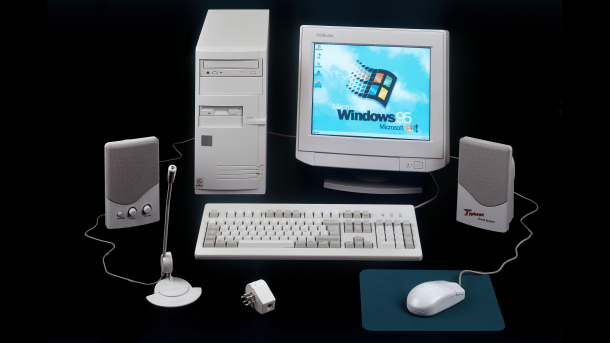
Contemporary Windows 95 PC with simple loudspeakers, CD-ROM drive and microphone.
(Image: CapturePB / Shutterstock)
On August 24, 1995, Windows 95 went on sale in the USA – and, like the first iPhones later on, it was a social event. Some people camped out in front of the electronics stores, weeks before an advertising campaign had been launched with "Start me up" by the Rolling Stones blaring from every television set. The song was already 14 years old at the time, but it fitted in perfectly with the new "Start" menu that Windows 95 brought with it.
To clear up one of the cliché jokes right away: Yes, you really did have to click on "Start" to switch off the PC. At the same time, under MacOS you also had to throw CDs or floppy disks into the trash to get them out of the drive. The metaphors of operating systems were even less sophisticated 30 years ago than they are today. And another myth: The Rolling Stones did not receive 12 million US dollars for their song, as even c't reported as a rumor in 1995, but only three. This is what Microsoft's COO Bob Herold said in 2011 after he had retired.
Microsoft was in a bind
In many reviews of the hype that Microsoft created around its first true hybrid of DOS and graphical user interface, the reason for this is lost: in 1995, the Windows company had competition from professional users and was in danger of missing the boat when it came to PCs for the home. The real successor to Windows 3.0 from 1990 was far too long in coming; the next major version was supposed to appear as early as 1993. However, only Windows 3.11 was released, which at least added slightly better network functions to Windows 3.1, which had appeared a year earlier.
However, OS/2 from IBM was always better in this area. Network cards and their drivers were easier to configure and connect to the many proprietary network systems commonly used by local servers at the time. Initially developed together with Microsoft so that Windows programs could also run under OS/2, the two companies ended this cooperation in 1990. In 1994, "O2/2 Warp 3" was even released, a version with a more stylish interface designed to appeal to private users.
Competition from IBM and consoles
Many Windows and DOS programs could also run under OS/2, and IBM advertised vigorously, in Germany with the slogan "Ich hab's drauf" (I've got it). This meant that computers with pre-installed OS/2 were also sold at the large PC chains Escom and Vobis. With a new generation of games that made use of sound cards and CD-ROM drives, PCs also became increasingly attractive compared to earlier home computers and consoles. The latter had also received a major boost at the end of 1994 with the first Playstation.
1995 was therefore a time of upheaval, not least because the Internet was becoming increasingly interesting for both professional and private users. For Microsoft, the most important thing was to immortalize itself on the growing number of PCs in homes. For this reason, Windows 95 could be tested on tens of thousands of PCs from the beginning of 1995 with a – partly paid – beta program. As early as July, it was announced that the system would be available a month later. At the same time, the advertising campaign was launched, which was to cost 200 million US dollars. According to current inflation calculators, that would be over 400 million today, more than even the biggest Hollywood productions cost.
Plug & play? Yes, but...
Looking back, many may remember that Windows 95 was a lot of trouble. The promise of plug-in cards that were supposed to configure themselves with the new "Plug & Play", which didn't always do so, and many crashes may be stuck in the memory. But not that Windows 95 already came with many drivers for common devices, as well as installation wizards that at least attempted to correct errors.
It also remains true that Windows 95 was still not a "real" operating system, which, like Windows NT 3.1 released in 1993 for workstations and servers, did not require a DOS substructure. In fact, Microsoft was only able to unite the colorful interface of Windows 95 and the technology of Windows NT with Windows 2000 in its namesake year –, only to turn everything upside down again with Windows XP just one year later.
However, it is true that Windows 95 came with the DOS version 7.0 developed for it, which was extensively integrated with Windows. Unlike Windows 3.11, drivers and programs were able to exploit all 32-bit functions of processors such as the new Pentium. In particular, 32-bit drivers needed neither DOS nor BIOS, although they were not available for all devices. And 16-bit programs were also still widespread. This often meant that protected mode and memory protection were no longer available: a single program or driver could cause the entire computer, including DOS and Windows, to crash. Pressing the reset button and waiting several minutes to boot from the then lame hard disks was the order of the day.
Microsoft's own Internet
However, this was the exception, not the rule, for a carefully assembled computer in terms of both hardware and software. But private users in particular had not been told this and often happily installed any software from the CD supplements of some magazines or from the Internet. This often resulted in very unstable systems. Microsoft boss Bill Gates also made one of his biggest mistakes when it came to the Internet, as he later admitted.
In the USA around 1995, proprietary online services such as AOL and Compuserve were the norm for networked communication. They also offered access to the Internet, but via their own software, which was distributed en masse for a wide variety of computers. You could even get a Windows 3.11 online through a modem without much effort. Such services also had their own mail and forum services, and large media outlets also offered their content there, a kind of parallel Internet. For the often private users, things like news or travel tips were not "on the Internet", but "on AOL", for example.
Videos by heise
Browser only in the Plus package
Microsoft also wanted to conquer this market, so "The Microsoft Network", the MSN, was launched with Windows 95. This was installed with the new Windows, but not even its own browser. Although "Internet Explorer" was also developed for Windows 95, it was only included in the "Plus!" package, which could be purchased for 50 US dollars. DirectX also proves that not everything that was once planned made it into the first edition of Windows 95: Microsoft's gaming API did not appear until September 1995. Without the Win32 interface, which Windows 95 already had, this would not have been possible either.
Even if operational reliability was not always guaranteed due to the mixing of 16- and 32-bit components, see above, the pre-emptive multitasking of Windows 95, together with the uniform interface, made the system a success. Because, at least in theory, on a clean 32-bit system, Windows controlled the reigns of time distribution to programs, everything felt much faster and more intuitive. At least if you had enough main memory: 4 MByte was recommended as a minimum, but Windows 95 was only really fun with 16 MByte or more. Even back then, you shouldn't take the hardware recommendations too seriously.
The first friendly PC
However, the biggest success of Windows 95 was the user interface: Start menu, installation wizards, a desktop that could be freely assigned – all minimum expectations of an operating system today. And things that Amiga and Macintosh, among others, were already able to do ten years earlier. Microsoft knew this too, so in 1995 they finally had to counter. For many people, Windows 95 turned a PC from a boring DOS office box into a fun device for the first time. By the end of 1995, Microsoft had sold 40 million licenses. Windows 95 was provided with updates until 2001.
Empfohlener redaktioneller Inhalt
Mit Ihrer Zustimmung wird hier ein externes YouTube-Video (Google Ireland Limited) geladen.
Ich bin damit einverstanden, dass mir externe Inhalte angezeigt werden. Damit können personenbezogene Daten an Drittplattformen (Google Ireland Limited) übermittelt werden. Mehr dazu in unserer Datenschutzerklärung.
The sound that Windows 95 plays when it shuts down shows just how much the company wanted to change: This is, in fact, the startup sound of Windows 3.11, as heard in this YouTube video, for example. Microsoft wanted to give itself a new, friendly image. The Windows startup sound, composed especially for Microsoft by Brian Eno, was intended to make the change audible. Microsoft wrote at least a little piece of IT history with Windows 95: in 2025, "The Microsoft Sound" was added to the US Library of Congress as an important historical work.


(nie)


