


Well predicted: Google's AI model showed its skills during Hurricane Erin
Google's AI weather model stood out from established models in the 72-hour forecast for Hurricane Erin. Why AI offers a number of advantages.
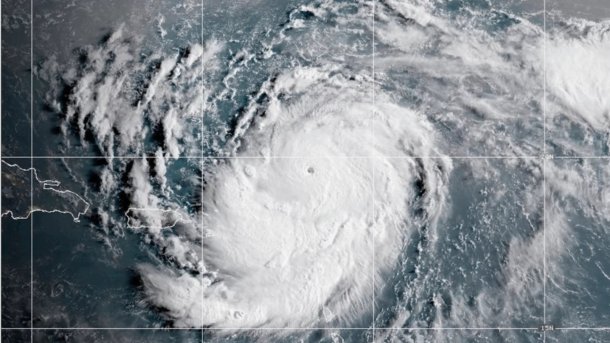
Hurricane Erin on a satellite image from the US weather agency NOAA
(Image: NOAA)
Google's efforts to make weather forecasts with the help of artificial intelligence are once again attracting a great deal of attention from experts: the experimental system recently outperformed established weather models in forecasting the further course of Hurricane Erin. The storm, which at times reached the highest category 5 on the Saffir-Simpson scale, was observed with concern by residents of the US East Coast. In the first 72 hours, the Google DeepMind model showed the best track and intensity forecasts for Erin across all forecasts, according to data from former US National Hurricane Center Division Director James Franklin.
It was only in June that Google introduced the Weather Lab, its own website for the experimental forecasting of hurricanes. The site, which is managed by Google DeepMind and Google Research, provides AI model forecasts online that cover up to 15 days and show 50 possible scenarios.

AI combines opposing models
At the launch, Google explained in a blog post that conventional weather models can either predict the track or the strength of hurricanes, but not both at the same time. The reason for this is that the path is determined by large-scale air currents, while the strength depends on complex processes in detail. Google's AI model combines both by bringing together global weather data for the entire earth with detailed observations of 5.000 hurricanes over the past 45 years.
The hurricane forecast is part of an overall package of AI developments relating to weather forecasting that Google is driving forward. With models such as GraphCast and GenCast, the company has already achieved initial success in traditional weather forecasting and extreme weather prediction.
Faster than supercomputers
A key advantage of AI models is their speed: while traditional weather models have to spend hours or even days solving complex atmospheric equations on supercomputers, AI systems can generate forecasts in minutes.
Videos by heise
For European users, it will be exciting to see how the collaboration with the European Center for Medium-Range Weather Forecasts (ECMWF) develops. GraphCast is already being used by the ECMWF, which is conducting a live experiment with the model forecasts on its website.
Still room for improvement
Nevertheless, Google's AI model still has room for improvement: The example of Erin, for example, showed that the model had missed the critical turning point when the hurricane turned north into the open sea. Nevertheless, many meteorologists are impressed by the fact that the AI has very quickly caught up with established models or in some cases overtaken them. The speed at which Google's forecast is developing is also unusual. Traditional models have developed much more slowly, which is why many are excited to see how good the AI predictions will be in the near future.


(mki)

