


Switch 2: USB-C devices fail due to Nintendo's device identification
Many USB-C docks with display output do not work with the Switch 2. Now the cause seems to have been found.
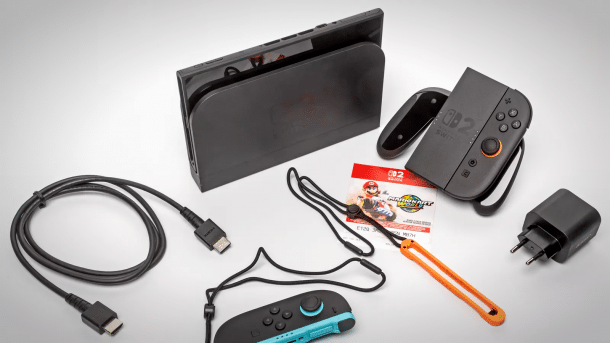
The Switch 2 is apparently only supposed to work properly with Nintendo's own dock, top center.
(Image: heise medien / wod)
Because Nintendo deals with numerous manufacturer-specific commands of the current USB protocol in a rather special way, many USB-C docks do not work with the Switch 2. This is the conclusion reached by the YouTube channel "Linus Tech Tips", which used a protocol analyzer to look at how the Switch 2 deals with accessories.
The testers came across common messages that USB-C devices with Power Delivery (USB-PD) use to negotiate voltages and currents as soon as the data connection is established. In modern USB systems, all parts of the chain, from the power supply unit to the cable to the consumer, have to play along and talk to each other.
This also applies to the "Alt-Mode", which transmits DisplayPort or HDMI signals together with the power supply via USB-C. This is the biggest attraction of the usual docks: only one cable leads from them to the host device, in this case the Switch 2, via which power then enters the console and images and sound come out of it.
For alt mode, the devices negotiate the available resolutions and refresh rates via manufacturer-specific messages via the USB protocol, the "Vendor Defined Messages", which appear as "VENDOR_DEFINED" in the transmission logs.
Nintendo apparently requests manufacturer ID via USB
According to a recent video and a blog article by LTT, Nintendo has apparently taken advantage of this so that Nintendo devices such as the manufacturer's dock sold for the Switch 2 are recognized in any case. For others, the direction of communication is reversed several times ("DR_SWAP") or restarted in parts ("SOFT_RESET") – At some point, the third-party device simply gives up. In between, and also with the Nintendo Dock, there is always the "DISCOVER_IDENTITY" request. USB devices can use this to output the name of their manufacturer, among other things.
In the case of the Nintendo dock, everything ran according to the pattern described above after the device ID – was reported, but LTT did not publish –, and the devices worked. However, even with a single monitor connected directly to the dock port of the Switch 2, the back and forth began and no image was displayed. The same applied to docks that worked with the first Switch. Shortly after the release of the new console, some accessory manufacturers suggested that Nintendo was using its own "encryption" for USB. However, according to LTT's experiments, this does not appear to be the case.
"Tactical laziness"
Instead, LTT accuses Nintendo of "tactical laziness". The console manufacturer is said to have only ensured that the usual functions such as alt mode work with its dock. And then no longer bothered to ensure that the negotiations about the features of other docks also worked. Something similar has already been observed with some firmware updates for the first Switch, where previously perfectly functioning accessories from third-party manufacturers suddenly stopped working.
Videos by heise
This situation is particularly strange because, despite the many functions of USB-C when used with PCs, compatibility problems have often improved in recent years. Many inexpensive docks for less than 50 euros with Power Delivery, Ethernet, HDMI output and some USB ports work on notebooks without any problems.
Empfohlener redaktioneller Inhalt
Mit Ihrer Zustimmung wird hier ein externes YouTube-Video (Google Ireland Limited) geladen.
Ich bin damit einverstanden, dass mir externe Inhalte angezeigt werden. Damit können personenbezogene Daten an Drittplattformen (Google Ireland Limited) übermittelt werden. Mehr dazu in unserer Datenschutzerklärung.
Nintendo's dock with built-in fan, also known as the"Switch 2 station set", costs 110 euros. As one is supplied with the console, it is particularly useful if you want to connect the Switch 2 to a different TV without having to rewire everything.
Nintendo doesn't have its solution for on the go
Or for on the go – a more compact version, such as the docks commonly used for notebooks, would also be practical. However, Nintendo does not even offer such a device itself. LTT was at least able to find a dock from the manufacturer Antank that works with the Switch 2 like the original. It seems that some providers are already gratefully playing the supposed cat-and-mouse game with Nintendo's USB specialties. Some have already provided firmware updates for their older devices.


(nie)


