


Brutal crash of the VMware Explore
VMware Explore counts less than a quarter of past attendees, yet Broadcom’s stock holds firm and even gains praise from investors on the exchange.
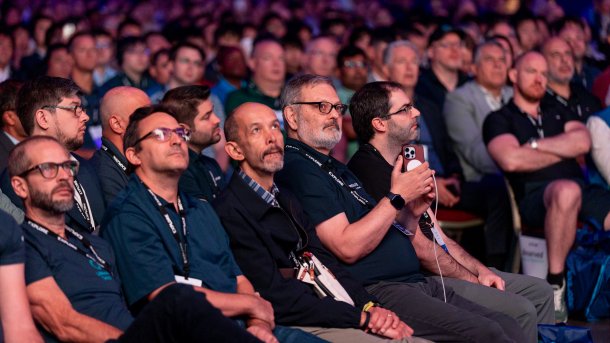
The enthusiasm of the already small number of participants was palpable.
(Image: Broadcom)
- Jens Söldner
At its in-house exhibition VMware Explore, which is now taking place exclusively in the USA following the discontinuation of the European offshoot this year, Broadcom further specified its strategy and announced products based on its VMware Cloud Foundation platform. VCF was only recently released in version 9.
Rarely before in the history of VMware has the manufacturer's strategy divided the customer base and community as much as it has since the acquisition by chip giant Broadcom, which was rather unpopular with customers. Supporters of the new strategy and partners who rely exclusively on VMware products see it in a positive light: Broadcom's CEO Hock Tan would have brought order to the chaos with thousands of products available to order. The fully integrated VCF platform has been created from the previous VMware product zoo around ESXi, vCenter, NSX, vSAN, Aria Automation and Operations and a few more, and the partner ecosystem has been properly tidied up.
"Partners who have been clogging up our ecosystem have had their authorization revoked," Laura Falko, responsible for Broadcom's global partner program, told European journalists of the changes still underway in the partner program. And, of course, Broadcom's share price is being celebrated, which has developed extremely positively since the acquisition of VMware two years ago. So from the shareholders' perspective, Hock Tan is doing everything right.
Horrified sponsors
The other half complains about the unappreciative treatment of customers, employees and partners, some of whom have helped to shape and enable VMware's success story for over 25 years. The rather harsh treatment of (now often former) employees, partners and customers causes a great deal of resentment.
The declining enthusiasm among users and the involuntarily decreasing number of partners was reflected in the number of participants, which set a negative record: Depending on the source, there were between 2500 and 5000 people in the sprawling conference center of the Venetian Hotel in Las Vegas. The result was deserted corridors, breakout sessions that were sometimes far below capacity and a yawning void in the exhibition area.
This was despite the fact that sponsors such as Microsoft, Google Cloud and AWS had supported the in-house exhibition of the competing, co-operating manufacturer with a substantial financial injection in the hope of making qualified customer contacts. In an interview with iX, they were appalled by the lack of customer meetings. Other long-standing partners who had been very active at previous in-house exhibitions were not represented at all – on X Veeam had already had to put up with the criticism that VMware had made the backup specialist big in the first place and now Veeam was paying VMware back with ingratitude and would not even appear as a sponsor or comment on VCF 9.

(Image: Screenshot / X)

(Image: Screenshot / X)
The mood among customers was also rather subdued: A few very large customers can certainly get to grips with the quasi-obligation to go to VCF. They too are seeking alternatives now that Broadcom is no longer perceived as a reliable and fair business partner in every customer house. This is due to the poorly communicated price increases and changes to the rules of the game that are perceived as unfair. One participant from a medium-sized US company put it in a nutshell in an interview with iX during a session: "We now pay VCF for a lot of software that we don't really use."
Hyperscalers AWS, Google Cloud and Microsoft were also less than pleased with Broadcom's behavior at and after the trade fair. As the diamond sponsors of the in-house exhibition, the three major cloud providers paid the lion's share of the exhibitor sponsorship. All other partner and manufacturer stands were significantly smaller and cheaper, so they had to be told in the first five minutes of the keynote on the first day that VCF was much better and cheaper than the hyperscalers' offerings anyway. Especially as it was rumored behind closed doors at the trade fair that another change would be coming on Friday after the end of VMware Explore, which the hyperscalers would not like – and it came promptly.
In a blog post on the VMware website, Abhay Kumar, Global Head of Managed Services at Broadcom's VCF division, announced that with the start of Broadcom's new fiscal year in November 2025. Hyperscalers will no longer be allowed to provide VCF licenses directly to customers. Instead, they will have to purchase them exclusively from Broadcom. The reasoning: After all, this would be easier and better for customers and would be in line with customer wishes, giving them even more control to determine the venue for their private cloud environments. However, the licenses were already portable before. Unsurprisingly, this announcement has not led to a storm of enthusiasm among hyperscalers. From Broadcom's perspective, however, this is only logical – they will now be treated no better than employees, partners and customers.

(Image: Jens Söldner / iX)
The new features for VCF
Regardless of the divided mood among the customers and partners present, the manufacturer naturally also had new features to announce in its platform. The manufacturer avoided naming the individual products, as bringing all customers onto VCF (or the smaller VVF variant if necessary) is the manufacturer's declared number one goal.
Compared to the original presentation and the simultaneous release of VCF 9 in mid-June 2025, VMware presented several innovations, changes and new partnerships in the keynote speech at the event. Under the motto of providing an infrastructure platform – advertised as "Infrastructure at the Speed of the Developer", VMware wants to continue to position itself with its flagship VCF as a fully "private" and more cost-effective alternative to the hyperscalers of the public cloud. Accordingly, the administrative breaks between the sub-products in VCF 9 have been further reduced and the installation and interfaces for operation by administrators and consumption by developers have been simplified and standardized. All of this can be described as successful on a technical level – Broadcom has therefore kept the promises it made a year ago about a simplified and powerful private cloud platform – Mission Accomplished, if you will.
A new addition is now integrated S3-compatible object storage, provided by VMware's vSAN storage component. Customers who require this important service for modern, cloud-native applications previously had to rely on external providers. VMware cites use cases in the areas of AI, DevOps and backup and disaster recovery as areas of application for the new S3 service. In the latter case, it probably makes primary sense to store the backup in a separate location; otherwise, a dedicated S3 appliance based on DataCore or ObjectFirst, a company founded by Veeam employees, is certainly a better option.
No longer supported in future versions are VMware's vVols, which the manufacturer introduced with vSphere 6.0 as an option to tightly integrate external storage systems with vSphere via special APIs. Technically quite innovative and groundbreaking, the vVols technology was not widely used – and does not benefit Broadcom economically either, as the manufacturer is concentrating on its own software-based vSAN storage service. In version 9.0, vVols are already no longer certified and are to be removed from the product in version 9.1, which is expected soon.
Other new features presented at the in-house exhibition are intended to expand the platform for developers and reduce the technical gap to the large hyperscalers. These include improvements to the Database-as-a-Service service VMware Data Services Manager from VCF, which runs on top of the VCF license price as a separately charged Advanced Service for VMware Cloud Foundation. A new feature here is that Postgres and MySQL databases can be distributed directly via this service. Integrated support for Kubernetes multi-cluster management, an ArgoCD implementation in VCF and integration of Istio Service Mesh are intended to support customers who rely on a GitOps approach.
The new partner: the free VMware alternative
Also exciting is the announcement of a partnership between Broadcom and Canonical, which is currently presenting itself on its website as a cheaper open source alternative to VMware. According to Paul Turner, Vice President of Product Development at VMware's VCF business unit, the partnership between Broadcom, which has released "the industry's first private cloud platform for modern private cloud environments, and Canonical, the maker of Ubuntu, the #1 cloud operating system" is designed to help customers increase developer efficiency, minimize security risks and simplify the deployment of AI applications. Specifically, VCF customers will have access to Ubuntu Pro with enterprise support, especially for Kubernetes containers, better security thanks to so-called chiseled containers, an offer by which Canonical means container images reduced to the absolute minimum. There will also be containers for faster deployment of AI workloads that include Ubuntu images and the necessary GPU drivers, adapted to the virtual environment.
Videos by heise
Of course, AI was also a must at the in-house exhibition and was one of the most important topics at the event after the platform itself. VMware had previously sold its VMware Private AI Foundation with Nvidia service as a paid add-on to VCF. With the start of Broadcom's new fiscal year in November, VCF customers will now have access to VMware Private AI services as part of their existing subscription at no additional cost.
The Private AI package includes services such as GPU monitoring, a model store and model runtime, an agent builder, a vector database, and other supporting functions. In the future, VCF customers will also have access to VCF Intelligent Assist, an AI-based support assistant (currently available in a tech preview). Support for the Model Context Protocol (MCP) is also planned. On the hardware side, VMware and Nvidia want to expand their existing partnership; VCF is to support the Blackwell architecture with the RTX Pro 6000 and Blackwell B200 GPUs; the same applies to the ConnectX7 and Bluefield3 network cards with 400 Gbit to be able to map the high network requirements of AI environments. Broadcom also wants to expand its VMware Private AI with the support of and by AMD. Customers will be able to use VCF with AMD's ROCm enterprise AI software package and the Instinct MI350 GPUs to fine-tune LLMs, provide RAG (Retrieval Augmented Generation) workflows and perform inferencing tasks in their data centers.
No other hopes either
In the subsequent press conference after the keynote, VMware's spokespersons had to face critical questions from the journalists present. Paul Turner, for example, dampened expectations regarding the individual purchase of vSphere Standard and Enterprise in the current version 9 –, as ESX and vCenter can certainly be downloaded as part of VCF 9. Turner emphasized that VMware's focus is currently on the overall platform and that he could not provide a date from which the core components would be available as classic vSphere.
Hopes for an official port of ESX to the ARM architecture –, which has been available as a preview for several years, were also dampened. In a technical session, a product manager responsible for this gave the participants hope that an ARM version would be released soon. But in the press conference, things sounded very different again – where no promises were made and it was emphasized that it was not a priority. VMware is currently only making a recording of the presentations and the slides available to participants who were officially registered at VMware Explore; they will be released to the general public at a later date. VMware employee William Lam has compiled the URLs of the presentation recordings and slides on GitHub.
In recent years, there has been a European edition of the in-house exhibition, which was last held in Barcelona in November. Broadcom had already canceled it at the last European Explore in November 2024. It will now be replaced by smaller regional events, the VMware Explore on Tour. The German edition will take place on November 11 and 12 in Frankfurt, with an entrance fee for the event. There will also be another VMware Explore USA at the end of August next year in Las Vegas – The bets of the attendees were that this year's Explore would also mark the end of the VMware in-house exhibitions.


(vbr)


