


EventSourcingDB 1.1 offers more flexible consistency control and signed events
The database specializing in event sourcing introduces eventual consistency and signed events in version 1.1.
(Image: the native web)
Version 1.1 of the EventSourcingDB database, which specializes in event sourcing, makes consistency control more flexible and increases security with digital signatures for events. Event sourcing is an architectural process that maps all changes to the state of an application as a sequence of events.
In the new version of EventSourcingDB, consistency boundaries can not only be defined via aggregates, but also flexibly described via EventQL queries. With these Dynamic Consistency Boundaries (DCBs), teams can define exactly when strict consistency is necessary and where eventual consistency conforming to the official specification is sufficient. To this end, the Freiburg-based manufacturer the native web has implemented a new precondition that checks the database before writing events.
Events signed via Ed25519 are also new. The database generates the signatures on-the-fly, which enables key changes without having to adapt existing events. Client SDKs support verification, including hash checking in Go and JavaScript, with other languages to follow. This allows the integrity and authenticity of events to be reliably proven to auditors and regulators.
Videos by heise
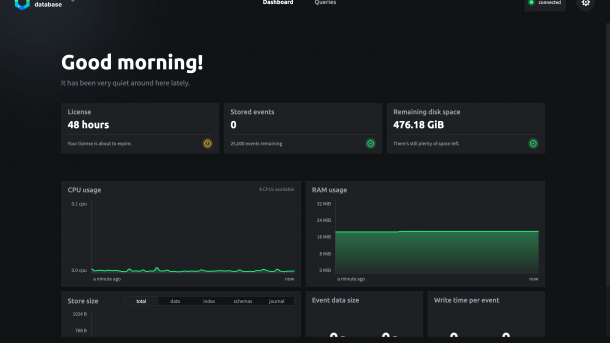
There are further refinements in detail: The integrated EventQL editor offers auto-completion for event types, new as well as more consistent API endpoints facilitate access, and the management UI has been slightly revised. Numerous optimizations in the background are intended to increase stability and developer friendliness.

(Image: the native web)
The EventSourcingDB is available as a Docker image and as a binary for Linux, macOS and Windows. Official SDKs are available for Go, JavaScript/TypeScript, .NET, PHP, Python, Rust and the JVM. Use is free of charge up to 25,000 events per instance. The provider is also launching a managed version as a private beta. It is aimed at teams who want to use the database without having to operate the infrastructure themselves.
(who)


