


Hue Bridge Pro controls 150 smart light bulbs, turns them into motion detectors
Philips Hue launches a new ZigBee gateway with more computing power and soft sensor tricks, adds cheap bulbs and some with Thread radio.
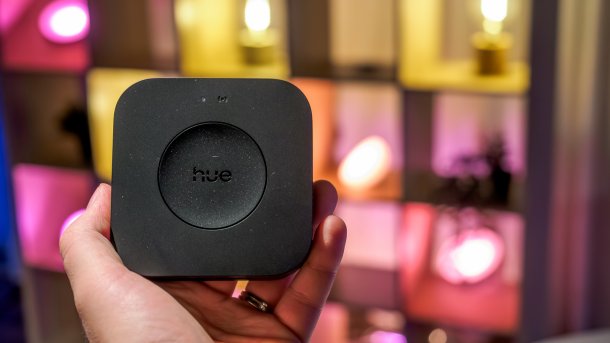
Black instead of white, 90 instead of 60 euros, 150 instead of 50 light sources – the new Hue Bridge Pro.
(Image: Berti Kolbow-Lehradt)
On the fringes of IFA 2025, lighting company Signify presented a long-awaited improved version of the ZigBee gateway of its Philips Hue brand. Unlike the Bridge v2, which is still available without the "Pro" suffix, the Hue Bridge Pro can manage more light sources and switching accessories. This makes it more suitable for large installations. It can also implement so-called soft sensors. It derives movement data from the positions and radio waves of light sources. This makes hardware motion detectors somewhat superfluous.
Philips Hue is also expanding its product range to include LED bulbs that work with Thread and can be integrated into smart home systems via the Matter standard without a Hue Bridge. The brand is also launching a more affordable "Essential" lighting range, a video doorbell and new control options via Sonos voice service and the in-house AI chatbot.
Hue Bridge Pro works via WLAN
A more powerful chip and more memory are intended to meet professional requirements and provide more capacity, speed and smart functions. The processor goes by the proper name of "Hue Chip Pro" and is based on a quad-core Cortex A35 with 1.7 GHz. It is supported by 1 GB of RAM and 8 GB of fixed memory. This means that the processor is five times more powerful and the memory is 15 times larger than that of the Philips Hue Bridge v2.
As a result, the Hue Bridge Pro can now be connected to up to 150 lamps and lights as well as 50 switches and sensors. It also stores up to 500 personalized light scenes. In addition to LAN, the new gateway can also connect to the home network via WLAN. This allows it to be located far away from the router.
There is no hard hardware limit for the standard bridge. However, the reliability of the switching commands decreases from 50 linked products. In addition, the bridge refuses to save more than 200 scenes. A LAN cable is the only way to establish contact with the home network.
"Soft" motion sensors built in
Philips Hue is now taking over the function from another Signify brand, Wiz, with which motion automation can be implemented without hardware sensors. The Hue Bridge Pro uses the locations of light sources and "interference" from their ZigBee radio waves as an indicator of whether someone is moving around in the room. Wiz does this without a bridge and purely via the WLAN connections in the brand's lamps.
Almost all Hue light bulbs serve as motion detectors. Exceptions are the first generation bulbs from 2012 as well as portable Hue rechargeable lights and ZigBee lights from third-party brands.
For reliable use, Philips Hue recommends at least three bulbs. If there are fewer, the motion detection will be too inaccurate. Sunrise and sunset times can be built into the switch-on and switch-off rules. However, real current brightness values as automatic triggers cannot be realized with the soft sensor technology. This is still only possible with the brand's hardware motion detectors. However, according to Head of Technology George Yianni, the company is working on being able to integrate the brightness data from physical sensors placed elsewhere in the household into the control mechanism of the Hue app.

(Image: Berti Kolbow-Lehradt)
The soft sensor technology can be used free of charge if it is used to control the light. If you want to use it to set security alarms with push notifications, you need a paid subscription for €0.99 per month. The Hue Bridge Pro itself costs 90 euros and will go on sale this September. It should be possible to migrate from an existing Hue gateway to the new Hue Bridge Pro at the touch of a button. Signify plans to deliver the option of transferring data from multiple bridges by the end of the year.
First Thread bulb – becomes Bridge Matter controller?
In addition to ZigBee and Bluetooth, a new LED bulb with an E27 base (60 euros) also works with Thread for the first time. This means that it can be integrated into other smart home systems using the Matter smart home standard without the detour via a Hue Bridge. Thread-capable smart speakers from Amazon, Apple and Google, for example, then serve as a switching point.
The Hue Bridge Pro itself does not support Thread. Just like the previous models, it continues to accept ZigBee connections. "We are not making a complete switch to Thread. The Hue system will remain ZigBee-based," explained George Yianni. He cited the more mature control logic and higher energy efficiency of ZigBee compared to the young Thread standard as the reason.
Technically, however, it would be possible to add Thread radio, at least in the Pro-Bridge, via a software update. In addition, Yianni did not rule out the possibility of the brand upgrading the gateway to a so-called matter controller. It could then control devices from various brands in the smart home, just like the large smart home systems. "This could be a very interesting development path", says George Yianni.
Videos by heise
Cheap bulbs, more security
The brand wants to appeal to prospective buyers with smaller budgets with an "Essential" range. It includes E27 lamps, GU10 spotlights (both from 25 euros in September) and bendable LED strips (from 60 euros in December). Unlike the high-price products, which are twice as expensive, they light up in a smaller white spectrum (2200 to 6000 Kelvin instead of 1000 to 20000 Kelvin), reproduce RGB color tones somewhat less accurately and can be dimmed to a minimum of two percent instead of 0.2 percent. Nevertheless, in addition to ZigBee and Bluetooth, a Thread chip is also built in.
Philips Hue's first security product for the front door is a 2K video doorbell (170 euros). With a wide-angle lens, you can identify visitors at the door from a distance and communicate with them using the intercom function. A smart chime (60 euros) from Hue can be plugged into any socket and makes the doorbell ring audible even in distant corners. Both devices will be launched in October.

(Image: Berti Kolbow-Lehradt)
Also from October, video recordings of the past 24 hours will be available free of charge for the first time and will no longer require a paid subscription. From next year, Hue also plans to deliver AI-supported facial recognition. It will be possible to control Hue lights with the Sonos Voice Control voice assistant via Sonos Wi-Fi speakers at an unknown date. It is a local alternative to Alexa, Google Assistant and Siri. However, as it only understands English and French instead of German, it is of little use in this country.


(dmk)


