

Presentation of the VW ID. Cross Concept: Free from experiments
The ID. Cross is Volkswagen’s key small EV - practical, not flashy, and set to become the bestseller among the brand’s five compact electric models.
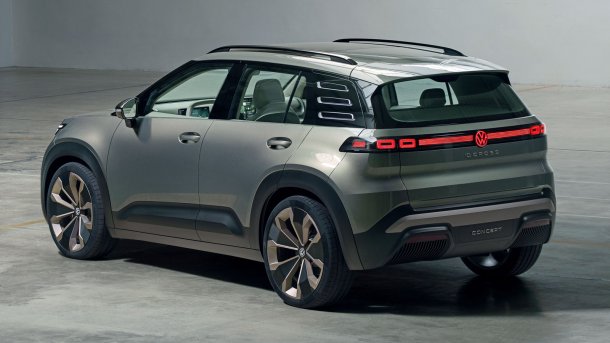
(Image: VW)
- Christoph M. Schwarzer
Volkswagen brings the ID. Cross Concept to the IAA: The production version of the concept car is due to be in dealerships after the summer break in 2026. The ID. Cross could be the electric small car from Volkswagen on this basis that achieves the highest sales figures. The manufacturer is very specific about some facts and data. In other areas, we have to speculate plausibly. The exterior of the VW ID. Cross Concept will change only minimally before the start of series production. The wheels with 21-inch rims, for example, will not be standard. The rest will probably be pretty much exactly as shown at the IAA in Munich.
Pressing instead of touching
In the interior, it is noticeable that Volkswagen no longer uses the wiper elements (so-called sliders). Instead, the steering wheel and the automatic climate control system have tangible pushbuttons and toggle switches. The new doctrine also includes a physical rotary control for the volume. The seating concept of the ID. Cross Concept is reminiscent of the Hyundai Inster: the driver and front passenger seats can be folded down. According to the press release, the backrests are "deliberately modeled on a very soft yoga mat". In a competitive environment with electric cars such as the witty Inster or the Renault 4 (where the front passenger seat can be folded down for long objects), Volkswagen will not be able to afford to completely dispense with a variable interior. Nevertheless, there are doubts about the full-length lying surface for the series launch.

475 liters of trunk space
The officially confirmed contents: The VW ID. Cross is 4.16 m long, 1.84 m wide and 1.59 m high. The wheelbase is 2.60 m. The trunk capacity of 450 liters is very large in relation to the external dimensions. This is thanks to a recess behind the rear axle. This figure is supplemented by 25 liters for a compartment under the front hood. Volkswagen states the towing capacity as 1200 kg and the drawbar load is 75 kg. This is enough to tow a light caravan or transport two e-bikes on a carrier. The output of the electric motor is 155 kW. The top speed is limited to 175 km/h. The ID. Cross is nothing more than an electric T-Cross. And just as the T-Cross is based on the Polo, the ID. Cross shares the platform with the Group's other small electric cars.
Front-wheel drive and a range of up to 420 km
Volkswagen has established the abbreviation MEB+ for the further development of the Modular Electrification Toolkit (MEB). Unlike the previous ID. models, the small cars have front-wheel drive instead of rear-wheel drive. The charging socket is mounted at the front right; all variants can be fast-charged with direct current. As far as the range and traction battery of the ID. Cross, Volkswagen provides virtually no information. According to the WLTP measurement procedure, the forecast is up to 420 km. At this point, the estimates start with reasonable assumptions.
VW ID. Cross Concept (7 Bilder)

VW
)Unclear cell chemistry
The energy content of such a traction battery is likely to be around 55 kWh. This version is likely to use the widely used cells with a cathode mixture of nickel, manganese and cobalt (NMC). All Volkswagen electric cars also have the option of manual or automatic preconditioning (i.e. heating or cooling) in order to achieve optimum performance when charging is stopped. However, the prospect of 20 minutes for the charging stroke from ten to 80 percent, which was made at the presentation of the ID.2all study at the beginning of 2023, would be extremely optimistic. It is more likely that a still good value of under 30 minutes will be achieved.
Entry-level version with around 300 km
In addition to the Renault 4, competitors include the Toyota Urban Cruiser. What they both have in common is that they offer an entry-level version with a range of around 300 km for less than 30,000 euros. Volkswagen will have to do the same in order to be competitive. It is possible that the inexpensive and robust LFP cell chemistry (for lithium iron phosphate) will be installed here. The energy content should be around 40 kWh. For comparison: Renault only installs NMC cells in the 4, while the Toyota Urban Cruiser always uses LFP cells. The decision in the automotive industry is obviously not clear-cut or uniform. Each cell chemistry has specific strengths and weaknesses. For example, LFP cells are particularly durable, but have poor charging performance at low temperatures. NMC cells, on the other hand, have a better energy density but are more expensive.
Videos by heise
Five small electric cars by the end of 2027
Back to what is actually known: five small electric cars will be coming from the Volkswagen Group by the end of 2027. The first is the Cupra Raval, which, like the VW ID. Polo, will go on sale in 2026. This will be followed in the course of the year by the Volkswagen ID. Cross and Skoda Epiq. Finally, the ID.1 subcompact car with a shorter wheelbase will appear. Its prices are expected to start at a good 20,000 euros. The ID.1 will be the first Volkswagen to use Rivian's software architecture. Furthermore, it should not be ruled out that the Volkswagen Group will follow up with further offshoots based on the MEB+.
All assistance systems available to order
Volkswagen says nothing about the assistance systems in the ID. Cross; the contents of the ID. Polo are directly transferable. In short, all assistance systems that are also installed in other model series will be available. From Travel Assist (adaptive cruise control plus lane center guidance) to the 360-degree camera, everything can be ordered. Traffic light recognition is entirely new.
The entry-level price will probably have to be below 30,000 euros if Volkswagen wants to find enough buyers in Germany and Europe. For the larger traction battery and with additional equipment, it will easily be 35,000 to 40,000 euros. The growing competition in this segment is stimulating business – and could dampen the real final price for customers.
(mack)