

Presentation of the Cupra Tindaya study: Wild as a concept
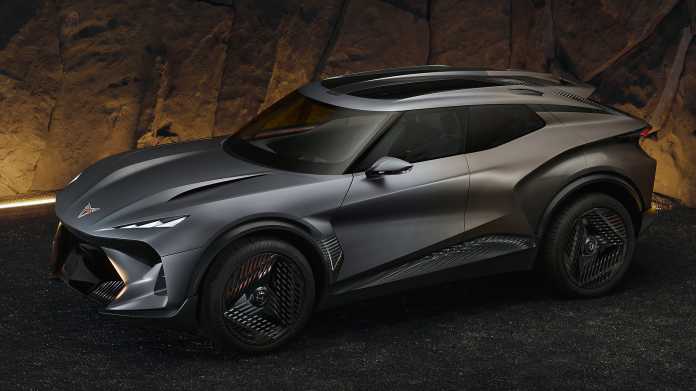
With its polarizing design, the Tindaya study is intended to show the direction the Cupra brand could take.

(Image: Cupra)
In the vastness of the Volkswagen Group, hardly any other brand is allowed to venture as far as Cupra in terms of looks. In fact, the Tindaya concept car is hardly likely to be close to series production, and yet the spectacular design is more than just an eye-catcher at the IAA. The name Tindaya, after a volcano on the island of Fuerteventura, certainly says it all.
Terramar, Tavascan, Formentor, and also the Ateca, whose production will be discontinued in the foreseeable future: The Cupra brand has no shortage of SUVs at the moment. Is there room for another model with a length of around 4.7 m? Yes, apparently the people in charge thought so. The Tindaya study is 4.72 m long and is designed exclusively for battery-electric drives. Which platform would be used in a production model is currently still of secondary importance. There is much to suggest that it could be the basis for the upcoming VW ID.4.

23-inch rims
The angular, folded design is deliberately exaggerated. The statutory pedestrian protection alone would probably prevent this front end from being used in series production. Huge wheel arches, in which even 23-inch rims and tires with a low sidewall height do not seem excessive, probably have a better chance. Inside, there are four individual seats, a 24-inch display, a gaming-style steering wheel, and a center console reminiscent of the 2023 Lamborghini Lanzador study. In the middle of the console, which extends all the way to the rear, there is a central button that can be used to control various functions.
Videos by heise
250 kW power in the top-of-the-range model—at least
An excitingly designed series model would presumably make use of the group's modular system for the drive components. Rear-wheel and all-wheel drive would be possible. The power range is likely to be between 210 and 250 kW, although we expect that Volkswagen may feel compelled to up the ante in this respect at some point. After all, there is no end in sight to the arms race—quite the opposite: the switch to electromobility makes more power comparatively easy, which will have more of an impact on road safety than on the demand for driving energy.
Cupra Tindaya (7 Bilder)
Cupra
)Volkswagen, for example, has shown with the APP550 electric motor that even 210 kW peak power can potentially be carried without dramatically exceeding the consumption of a small electric car like the Opel Corsa-e. In this respect too, combustion engines and battery electric drives differ enormously. The potential of a supercharged V8 will always have to be fed to some extent, even with a moderate driving style. With the incomparably more efficient electric motor, consumption only increases when the power is called upon.
Charging capacity: 200 kW plus X
The world at Volkswagen is divided when it comes to charging power. Audi and Porsche already have models with a voltage level of 800 volts, which allows charging power of significantly more than 200 kW on the standard charging infrastructure, which is protected with 500 amperes. Brands such as Skoda, VW, and Cupra currently use a 400-volt system. This is the peak at charging stations with 500 A at 200 kW. In the medium term, other Group brands will also include electric cars with 800 volts in their range. It is uncertain whether a production version of the Tindaya study could be one of them.
(mfz)