


Dutch Hyperloop system reaches 85 km/h and changes lanes
On the European Hyperloop route in the Netherlands, a Hyperloop capsule was able to change lanes and reach 85 km/h.
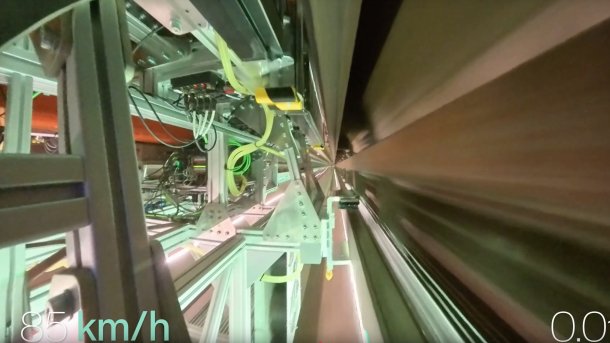
The Hyperloop superstructure from Hardt Hyperloop accelerates to 85 km/h.
(Image: Hardt Hyperloop/Screenshot)
The Dutch company Hardt Hyperloop has tested its Hyperloop system on the track of the European Hyperloop Center (ECH) in Veendam, the Netherlands, reaching a speed of 85 km/h. This was announced by Hardt Hyperloop on Wednesday. The company was able to perform a lane change maneuver during the test run. With appropriate scaling, speeds of up to 700 km/h are possible.
Contactless lane change
The capsule from Hardt Hyperloop accelerated to a top speed of 85 km/h at 0.3 G on the first 140 m of the 420 m long ECH test track. The Hardt Hyperloop capsule is only designed for speeds of up to 80 km/h. In a subsequent 155 m long section, the capsule performed a lane change and then came to a gentle stop on the last 100 m of the test track.
“Demonstrating lane changing at these speeds—in this environment—is a major leap from theoretical designs to real systems and an important accelerator for scalable Hyperloop implementation worldwide,” says Roel van de Pas, Managing Director of Hardt Hyperloop.
Empfohlener redaktioneller Inhalt
Mit Ihrer Zustimmung wird hier ein externes YouTube-Video (Google Ireland Limited) geladen.
Ich bin damit einverstanden, dass mir externe Inhalte angezeigt werden. Damit können personenbezogene Daten an Drittplattformen (Google Ireland Limited) übermittelt werden. Mehr dazu in unserer Datenschutzerklärung.
The Hyperloop lane change technology used by Hardt Hyperloop does not require any mechanically moving components. This is intended to increase the reliability of the already low-maintenance technology of Hyperloop systems.
The successful lane change within a Hyperloop system is the result of more than 750 test missions that Hardt Hyperloop has carried out on the ECH track since 2024. This was the only way to get the motionless lane change mechanism to work. It is also robust, safe, and can be scaled up to larger systems.
The Hyperloop capsule and system integration were improved during the many test runs. For example, the drive was integrated into the magnetic guide, the weight of the bogie was reduced by 45 percent, and the thrust increased by 50 percent. Hardt Hyperloop assumes that the system can be scaled up so that speeds of up to 700 km/h can be achieved. The potential to realize high-speed, long-distance transport using Hyperloop technology is therefore there.
Videos by heise
For the future, Hardt Hyperloop is planning to build an initial three- to five-kilometer demonstration track to test the technology on a larger scale. This will be followed by a 30 to 50 km long operating route to make Hyperloop technology ready for commercial applications.



(olb)

