


Class action lawsuit: RAM clock frequencies are misleading
In the United States, Corsair is expected to settle after three years of litigation. Consumers complained that the clock speed specifications were misleading.
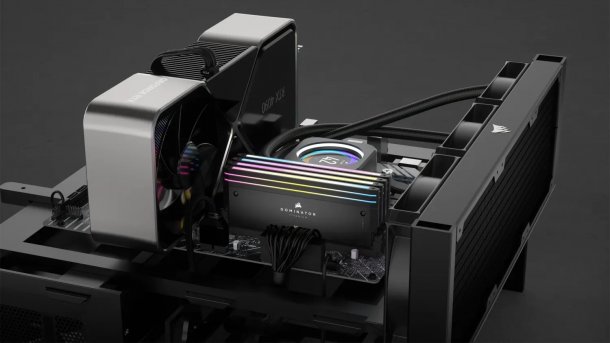
(Image: Corsair)
In the USA, Corsair and McKinney are to agree on a settlement. The corresponding settlement proposal is being driven by a federal court. It concerns the stated clock frequencies for RAM kits. Manufacturers always advertise the maximum possible clock frequencies for which their latches are designed, for example DDR4-4000 or DDR5-8000. However, these specifications are no guarantee that a PC will achieve the clock frequencies. This still depends largely on the memory controller in the processor, the mainboard and ultimately also the chip quality.
Maximum clock speed is not set at the factory
When delivered, every RAM bar works according to the JEDEC standard (Joint Electron Device Engineering Council). The standard frequency of DDR4 modules is 1067 MHz (DDR4-2133) and of DDR5 modules 2400 MHz (DDR5-4800). In order for the RAM to reach the promised clock frequencies, users must either load a suitable overclocking profile in the motherboard BIOS (Intel XMP or AMD EXPO) or adjust the settings manually.
Videos by heise
Tom's Hardware draws attention to a class action lawsuit that is explicitly directed against Corsair. However, other RAM manufacturers are taking the same approach. After three years of litigation, a settlement is now in the offing to resolve the class action lawsuit. The current settlement proposal is for 5.5 million US dollars. US citizens who purchased Corsair modules between 2018 and 2025 have until October 28, 2025 to submit claims. Corsair and other manufacturers could add an "up to" to the clock specifications in the future to avoid legal problems.
Empfohlener redaktioneller Inhalt
Mit Ihrer Zustimmung wird hier ein externer Preisvergleich (heise Preisvergleich) geladen.
Ich bin damit einverstanden, dass mir externe Inhalte angezeigt werden. Damit können personenbezogene Daten an Drittplattformen (heise Preisvergleich) übermittelt werden. Mehr dazu in unserer Datenschutzerklärung.


(mma)


