


Android 16 QPR2: Second beta brings customizable app icons for Pixel 6 and newer
Google has released the second beta of the next major Android 16 update. Among other things, the QPR2 beta has customizable app icons and more on board.
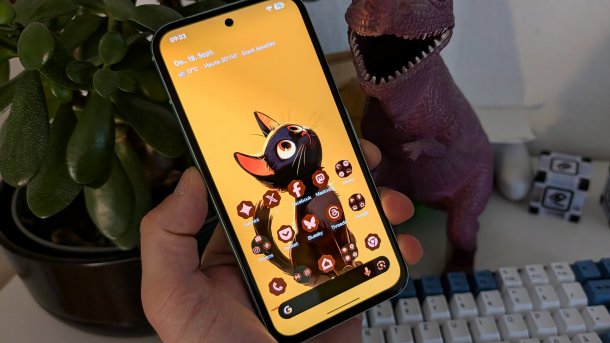
Android 16 QPR2 is expected as a Pixel Drop in December.
(Image: Andreas Floemer/heise medien)
Google plans to launch the second quarterly version of Android 16 this December, which will be released as Pixel Drop for Pixel smartphones. With the second beta version now released, the update has reached platform stability, which means that the API interface is locked and the app-related functions are final. This allows developers to adapt their apps to the new version in order to be able to use the latest platform functions.
Beta 2 of the QPR 2 update (Quarterly Platform Release) brings some new features. Among them: a long-awaited customization function for app icons.
Customizable app icons
With the QPR2 update, Google is integrating the option to change the shape of app icons on the home screen. In addition to the classic round shape, the manufacturer offers four other options in the settings. The icon shape is also applied to folders on the home screen. Apps in the app overview remain untouched.

(Image: Andreas Fleomer/heise medien)
In addition to this new option, Google had already introduced automatically customized app icons in the first QPR2 beta to create a uniform look and feel for all apps on the home screen. According to Google, the system applies a color filter algorithm to the existing app icon "to display it in a monochrome style so that it can be integrated into the theme chosen by the user".
SMS OTP protection
Google is also adding a new security feature with Android 16 QPR2 that delays the delivery of messages containing an SMS retriever hash by three hours. This is intended to help prevent OTP hijacking ("One Time Password" – one-time password) by apps that have access to the SMS database. According to Google, "RECEIVE_SMS transmission" is thus held back and database queries from SMS providers are filtered during this three-hour period.

The standard SMS, assistant and dialing apps as well as the companion and system apps of the connected devices, are exempt from this delay.
Health Connect becomes a pedometer
Google's Health Connect will also receive an update and will be able to count steps automatically via the device sensors in the future. This is practical for anyone who does not want to use a separate fitness app.

(Image: Andreas Floemer/heise medien)
Relevant for developers: If your own app has the "READ_STEPS" authorization, this data will be available in the "android" package. According to Google, this not only simplifies the code required for step tracking, but is also more energy-efficient. The "ExerciseSegment" and "ExerciseSession" data types have also been updated. They can now record and read out weight, set index and subjective perception of exertion (RPE) for exercise segments.
Test run of the developer review
With QPR2, Google is adding new APIs to the system that support the developer authentication feature $(LB4924722:$ announced by Google last month. From fall 2026, it will only be possible to install applications whose publisher has previously registered with Google and signed the respective application. This has already applied to installations via the Google Play Store since 2023; anonymity will now also be abolished for sideloading, i.e. for app files that are installed outside of the Play Store.
Google explains that developers can install apps without verification using ADB so that they can continue to test apps that are not intended for the masses or are not yet ready for distribution. There is also a new ADB command that developers can use to simulate a verification result for testing purposes.
adb shell pm set-developer-verification-result
With this command (full details can be found under "adb shell pm help") developers can simulate verification errors. "This allows them to understand the end-to-end user experience for both successful and failed verifications and prepare accordingly before enforcement begins," Google explains.
Videos by heise
With the new Android version, the Android Runtime (ART) receives a so-called "Generational Concurrent Mark-Compact (CMC) Garbage Collector". This is a type of garbage separator that "focuses on newly assigned objects that are more likely to be considered garbage", according to Google. Among other things, the function is intended to ensure "lower CPU usage due to garbage collection, a smoother user experience with less stuttering and improved battery performance".
From Pixel 6 to Pixel 10
According to Google, QPR2 is the first Android version with a smaller SDK version. This should make it possible to develop new functions with new platform APIs more quickly, which can be provided outside of our usual annual schedule. Unlike the major Android 16 update released in early June, which brought behavioral changes that impact app compatibility, "the changes in this release are largely additive and designed to minimize additional app testing".

(Image: Google)
The new Android beta with the build number BP41.250822.010 is available for the Pixel 6 and newer – including the Pixel 10 series – ready for testing. If the stable version of Android 16 QPR1 is installed on the device, the best way for users to upgrade it to the new beta is to register their Pixel for the Android beta program. If the device is already registered, it will automatically receive the new version via an over-the-air update (OTA).


(afl)

