


TUM: Autonomous underwater robot system to combat waste problem in ports
TUM declares war on waste in ports. A system consisting of an unmanned boat, underwater robots and drones autonomously detects waste in the water and removes it
(Image: Andreas Schmitz/TUM)
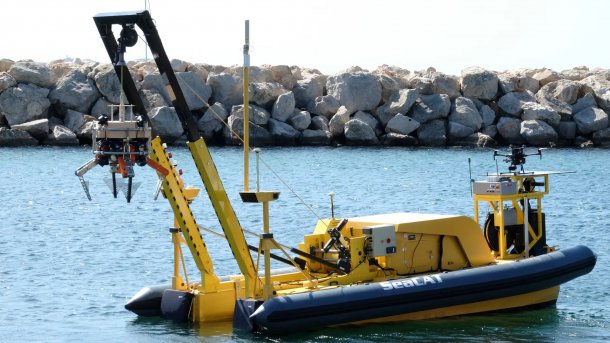
As part of the EU project "Seaclear," a research team at the Technical University of Munich (TUM) has developed an autonomous underwater robot system that combines specialized robots, a drone, and a service boat to detect trash above and below the water and collect it using robots. The system is primarily intended for use in port areas where pollution levels are particularly high.
Many ports are full of waste: fishing nets, bicycles, e-scooters, and old tires are just a few examples of the waste that is carelessly disposed of in harbor basins. In the port area of the Croatian city of Dubrovnik alone, a total of over 1,000 pieces of waste were located in an area of 100 m², according to a statement by TUM scientists. This was reason enough for the researchers to develop a system for autonomous underwater waste disposal.
Specialists for individual tasks
The TUM system envisages autonomous robots, drones, and boats specialized for individual tasks working together in a network. To this end, TUM uses the unmanned SeaCat service boat with a dinghy, a drone, and an underwater robot to detect the waste, as well as a diving robot with a grabber. The service boat serves as a control center from which the robots operate. It supplies power to the two robots via a cable and also establishes a data connection with them. In addition, the boat can use ultrasonic waves to make an initial rough map of the harbor basin substrate.
Empfohlener redaktioneller Inhalt
Mit Ihrer Zustimmung wird hier ein externes YouTube-Video (Google Ireland Limited) geladen.
Ich bin damit einverstanden, dass mir externe Inhalte angezeigt werden. Damit können personenbezogene Daten an Drittplattformen (Google Ireland Limited) übermittelt werden. Mehr dazu in unserer Datenschutzerklärung.
Empfohlener redaktioneller Inhalt
Mit Ihrer Zustimmung wird hier ein externes YouTube-Video (Google Ireland Limited) geladen.
Ich bin damit einverstanden, dass mir externe Inhalte angezeigt werden. Damit können personenbezogene Daten an Drittplattformen (Google Ireland Limited) übermittelt werden. Mehr dazu in unserer Datenschutzerklärung.
A more accurate scan of the harbor floor is then carried out using a small underwater robot, approximately 50 cm long, which provides detailed data on potential waste in the harbor basin via camera images and sonar. The data is evaluated by artificial intelligence (AI), which marks possible waste objects and at the same time processes them in three dimensions in order to give the diving robot with a gripper precise instructions on how best to grasp the object.
The diving robot then dives to the appropriate position with its eight mini turbines to pick up the object with its four-fingered gripper. With a force of up to 4000 Nm, the gripper can grasp and pick up objects weighing up to 250 kg. In order to pick up the objects in a targeted manner rather than simply crushing them, the gripper is equipped with sensors that enable sensitive gripping. The robot and the waste are then pulled on board using a winch.
Videos by heise
The drone is designed to detect trash on the water's surface so that it can be picked up by the robot. The entire system is designed to operate completely autonomously. Tests in the port of Marseille in southern France were successful. According to the scientists, the system is already cost-effective for operations at diving depths of 16 m or more.



(olb)

