


Estonia Defence Week: Estonia puts up a smart fight
A few days after the border breach by Russian MiGs, Estonia has a Defence Industry Park. Companies are planning a drone wall for NATO's eastern border.
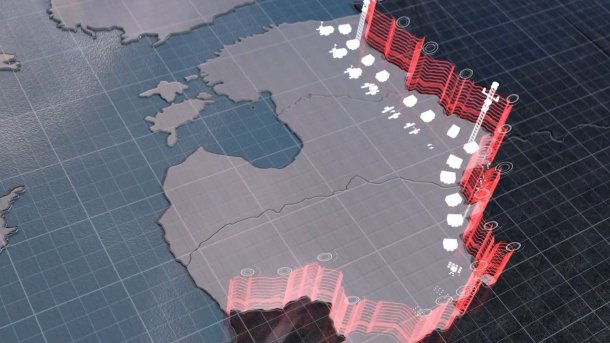
(Image: Defsecintel)
A coincidence of dates that could not have been imagined: Firstly, the first Estonian Defence Week kicked off in Tallinn, the capital of Estonia, on Monday, 22 September 2025. Until Friday, the country is attracting visitors with conferences on security architectures and technical innovations as well as a trade fair with 300 mostly Baltic defence technology providers. On the other hand, the UN Security Council also met in New York on Monday at the request of the eastern Baltic state to discuss the violation of Estonian airspace over the Baltic Sea by Russian fighter jets on Friday, 19 September 2025. On Tuesday, the defence alliance also met in Brussels at the request of NATO partner Estonia. In light of this latest development, Estonian Defence Week is taking on a special dynamic, as if the recent border violation has further fuelled the will of the Balts to assert themselves.

(Image: Erlend Štaub)
Estonia has been relying on software and digitalization expertise for years. Not only did the country implement all administrative processes for its 1.3 million citizens online as e-services twenty years ago, including, for example, a pre-filled three-click tax return that most citizens can complete in just a few minutes. IT expertise is also considered an export opportunity. “Smart defence technology is a key cornerstone of this,” emphasized Estonian Minister of Economic Affairs Erkki Keldo at the press conference. Key areas include unmanned ground vehicles (UWS), unmanned aerial vehicles (UAV), drone defence and cyber security. It is no coincidence that the NATO Cooperative Cyber Defence Centre of Excellence (CCDCOE) is also located in Tallinn.
Smart defence technology from Estonia has already made impressive progress in recent years, increasing its export sales from 46 million Euro in 2020 to 350 million Euro in 2024. 193 mostly young companies have emerged in this sector in Estonia, 40 of which are start-ups from the current year. For 2025, Keldo forecasts a total turnover of 500 million euros in the defence technology sector; by 2030, this is expected to rise even further to 2 billion euros. At the same time, Keldo announced a budget decision on Tuesday, September 23, according to which the pure defence budget will rise to 5 percent of gross domestic product in 2026, without the state taking infrastructure measures into account.

(Image: Erlend Štaub)
The decision on a new Defence Industry Park, an industrial estate covering around 200 hectares specifically for the regional defence industry, on which an ammunition factory, for example, is to be built, is scheduled for Friday. Also planned for Friday are consultations on the construction of a Baltic Drone Wall or a so-called Eastern Shield on NATO's eastern border from Estonia to Poland.
Videos by heise
According to current plans, hundreds of mobile units with automated drone interception technology are to be stationed at the Drone Wall along the eastern border of Estonia, Latvia, Lithuania, and later Poland. On Tuesday, the CEOs of Defsecintel Solutions, the Estonian initiator of the Drone Wall, and the Latvian drone manufacturer Origin signed an agreement to integrate their systems for such an interceptor shield. Defsecintel has developed a vehicle with radar, cameras, and control software to detect attacking drones at a distance of 40 to 50 kilometers. Acoustic sensors are also planned at the border.
Origin is developing interceptor drones that will autonomously target the intruder, initially guided by the radar and later, when visual contact is made, using their camera images, and remove them from the sky with an explosion. The overall system should be open to other partners and components, such as guided missiles or other interception technology. For example, Defsecintel has also integrated drones from the German company Argus Interception into its system on a trial basis. The Argus drones can fire nets and thus disable slow-flying, observing drones.

(Image: Erlend Štaub)
“In view of the threat, we have to close our front door,” Defence Minister Hanno Pevkur told c't in a press interview. And in doing so, it will be important to develop safer and cheaper systems for drone defence. Estonia trusts its young defence force to have the necessary innovative strength.


(agr)


