


Snapdragon X2: Qualcomm presents the second generation of its notebook processor
The top model Snapdragon X2 Elite Extreme has 18 Oryon v3 cores and a more widespread memory interface. All variants benefit from the new NPU with 80 TOPS.
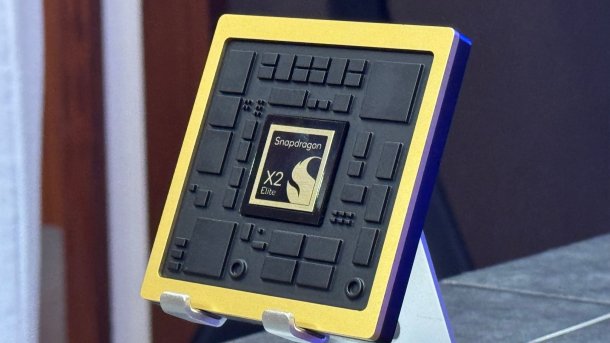
(Image: Florian Müssig / heise medien)
At this year's Snapdragon Summit, Qualcomm presented the second generation of its Snapdragon X notebook processor, which has been shaking up the market since mid-2024. In contrast to the confusing naming of the smartphone division, the PC processors are more civilised: the newcomer is called Snapdragon X2, which is as logical as it is simple. The first laptops equipped with it are expected to be in shops in the first half of 2026.
With the Snapdragon X2, Qualcomm is skipping the second generation of Oryon cores, which have already been available in smartphones (since the end of 2024), and jumping straight to the current third generation. Qualcomm promises up to 31 per cent more computing power compared to its predecessor and up to 75 per cent compared to other PC processors, in each case with the same energy consumption. However, Qualcomm has not yet provided any specific performance figures or benchmark results.
Prime and performance
Even with the first Snapdragon X, the three clusters of four cores were not completely identical; with the Snapdragon X2, Qualcomm is now advertising the distinction between prime and performance cores more prominently. The new top model Snapdragon X2 Elite Extreme has a total of eighteen CPU cores, divided into three clusters with six cores each (2 × Prime, 1 × Performance). The prime cores are designed to run on one or two cores at up to 5 GHz under load, with one "golden core" per prime cluster being used.

(Image: Qualcomm)
Qualcomm has not yet named any specific models of the X2 generation. There is also no information on the planned thermal design power (TDP). We would not be surprised if the Extreme model is allowed to burn more heat than other Snapdragon X/X2 Elite models. Qualcomm will only announce such details at a later date.
For the integrated graphics unit – previously the weak point of Snapdragon notebooks –, Qualcomm is promising a 2.3-fold improvement in graphics performance per watt; however, hard benchmark results are still missing here as well. At least the graphics unit now supports DirectX 12.2 Ultimate and thus also ray tracing under DirectX. With the first Snapdragon X, ray tracing could only be used via Vulkan and with a limited range of functions.
A significant part of the performance increase of the integrated GPU is likely due to a wider memory interface: prototypes of the Snapdragon X2 Elite Extreme passed around at the Snapdragon Summit have three memory chips on the processor carrier, which means 192 bits instead of the usual 128 bits. Memory-on-Package (MoP) is also used by other current notebook processors such as Intel's Core Ultra 200V or Apple's M4 family, but only with 128 bits for two LPDDR5X components. Qualcomm uses particularly fast LPDDR5X-9523, which results in a transfer rate of a whopping 228 GByte/s.

(Image: Florian Müssig / heise medien)
NPU frontrunner
So far, Qualcomm has only named a specific performance for the AI unit (Neural Processing Unit, NPU), which is still called Hexagon: after 45 TOPS (trillion operations per second) in the first Snapdragon X generation, the NPU performance in the X2 increases to 80 TOPS. This puts it clearly at the top of all processors for Windows notebooks.
Microsoft's Copilot+ marketing logo and the associated AI functions in Windows 11 still "only" require 40 TOPS, which only a few chip generations among AMD and Intel notebook processors currently achieve. AMD's Ryzen AI (Max) 300 aka Strix Halo, Strix Point and Krackan Point achieve 50 to 55 TOPS. Intel's Lunar Lake (Core Ultra 200V) achieves 40 to 48 TOPS, while the NPUs of the sister series Arrow Lake (Core Ultra 200U/H) remain below 20 TOPS. AMD and Intel are of course also working on chips for the 2026 notebook vintage, but they are unlikely to exceed Qualcomm's 80 NPU TOPS.
Videos by heise
Remote maintenance
Although remote maintenance at BIOS level is becoming less important because mobile device management (MDM) in the corporate environment now often takes place at the operating system level, Qualcomm has so far had nothing to offer Intel's vPro functions. This is changing in the second Snapdragon X generation with Snapdragon Guardian: the new function allows administrators to access devices below the operating system.
Qualcomm not only includes network connections via Wi-Fi using its own FastConnect 7800 Wi-Fi 7 adapter, but also access via mobile networks if the Snapdragon X75 5G modem is installed in the business notebook. Guardian can also be interesting for private customers if a notebook automatically deletes its SSD as soon as the owner has reported it stolen.
Note: Qualcomm invited the author to the Snapdragon Summit in Hawaii and covered the travel costs.
Empfohlener redaktioneller Inhalt
Mit Ihrer Zustimmung wird hier ein externer Preisvergleich (heise Preisvergleich) geladen.
Ich bin damit einverstanden, dass mir externe Inhalte angezeigt werden. Damit können personenbezogene Daten an Drittplattformen (heise Preisvergleich) übermittelt werden. Mehr dazu in unserer Datenschutzerklärung.


(mue)


