


Russian jet kamikaze drone with Raspberry Pi 4
The Ukrainian military intelligence service finds a Raspberry Pi 4 in the Russian Geran-3 drone with a Chinese jet engine.
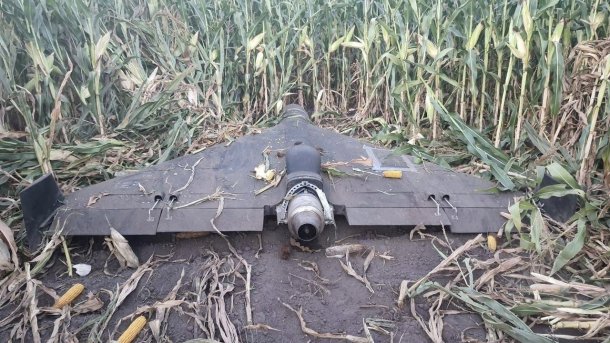
Russian Geran-3 drone after crash in Ukraine
(Image: Ukrainischer Militärnachrichtendienst (HUR/ГУР МО України))
The Ukrainian military intelligence service HUR (Main Intelligence Directorate) has examined a Russian Geran-3 drone that crashed largely intact. Among other things, it contained a Raspberry Pi 4 as part of the drone's so-called "tracker". The experts also found components from other European – also German – and US chip manufacturers, as well as components from Russian and Chinese production.
The investigation shows that export restrictions on chips for such weapons have no effect. The Russian developers even used some components from European manufacturers, for which there are very similar alternatives from Chinese companies. This also applies to the Raspberry Pi 4, as several Chinese brands produce single-board computers with comparable features and computing power, for example with ARM SoCs from Allwinner or Rockchip.
Furthermore, It is clear that Russia is developing drones with more functions and more complex technology. The Nvidia Jetson Orin single-board computer, which is probably responsible for autonomous control via AI, was found in another Russian drone.
According to HUR, the Geran-3 was also fitted with a camera and mesh video transmission system, which had already been found in a Geran-2 Type K. It is assumed that drones communicate in the swarm via the XK-F358 mesh modems from the Chinese company Xingkai Tech. According to Xingkai, the range is up to 300 kilometres.
The HUR documents which components were found in Russian weapons on the "War Sanctions" website. In addition to documentation, the aim is to obtain information about the routes taken by components to reach Russia.
Geran-3 vs. Shahed-238

(Image: Ukrainischer Militärnachrichtendienst (HUR))
Russia is attacking Ukraine with large quantities of relatively cheap aerial drones. The Ukrainian defence forces shoot down most of them, including with the Gepard II weapon system. However, the unmanned aerial vehicles (UAVs) that do get through cause relatively extensive damage and terrorise the civilian population. Some aircraft carry the TBBCh-50M (ТББЧ-50М) thermobaric warhead weighing around 50 kilograms, which also contains steel balls (shrapnel effect).
The drones currently in use include the Geran-2 type, which Russia manufactures itself but is closely related to the Iranian Shahed-136. It is powered by a 50 PS boxer engine, a replica of the Limbach L 550 E. The Geran-2/Shahed-136, also known as "mopeds" because of the engine noise, can fly up to 2000 kilometres at a speed of around 200 km/h.
Videos by heise
The Geran-3 (гера́нь-3) is said to be similar to the Shahed-238 presented by Iran in 2023, and both are externally similar to their predecessors. The most important difference is a small jet engine instead of a propeller drive, which means they fly significantly faster but not as far.
Geran-3 in the Ukraine
The Geran-3 drone under investigation was equipped with the TBBCh-50M warhead mentioned above. The engine used was a JT80 from the Chinese manufacturer Telefly. It is probably a replica of the Czech PBS TJ80-90.
In a press release, the HUR estimates that the Geran-3 can reach around 370 km/h, but cannot fly further than 1000 km. Earlier reports on the Geran-3 spoke of speeds of around 600 km/h. Apparently, the version actually produced uses a weaker engine.

The HUR also mentions that the electronics have been significantly improved compared to the Geran-2. For example, the Russian-made Comet-M12 (комєта-М12) satellite navigation system is used, which is said to be less sensitive to interference. It has an active directional antenna (Controlled Reception Pattern Antenna/CRPA) consisting of twelve elements. The Comet-M12 contains electronic components that do not originate from Russia or China, such as a PLD chip from Intel/Altera.
Several GNSS units and video radio
A GPS/GNSS receiver was also installed, which is capable of dead reckoning with an inertial sensor when the satellite signal is lost. To achieve this, the developers combined the ADXL357B 3-axis MEMS gyroscope from Analog Devices with the UBX-M8030-KT uBlox chip.

(Image: heise medien)
In addition, a third GNSS unit with the Chinese chip Unicore UC9810 and the DSP TMS320 from Texas Instruments (TI) was installed. Various power semiconductors from Infineon were used in the power distribution unit (PDU) and in the control system for the servomotors. The fuel pump comes from Bosch.
Microcontrollers were used from the European STMicroelectronics (including STM23H7, STM32F103 and STM32F0), from TI and from the Chinese company GigaDevice (GD32F103). The GD32F103 is often used instead of the STM32F103. Unfortunately, the report does not explain which sensors are analysed by the "tracker" in which the Raspberry Pi 4 operates.
Surprising choice of components
The selection of components installed in the Russian Geran-3 is partly surprising, but also suggests some conclusions.

(Image: Arduino)
Firstly, it becomes clear that the electronics only make up a small part of the manufacturing costs. The small jet engine alone is said to cost more than 10,000 US dollars.
From the perspective of Russian weapons developers, chips from Chinese manufacturers should have two major advantages: they are available without export restrictions and are presumably cheaper.
Nevertheless, the Russian developers chose some Western chips for which there are Chinese alternatives, see STMicro STM32F103 vs GigaDevice GD32F103. Voltage converter ICs are also available from Chinese companies such as TRR Electronics, but ICs from STM, for example, were installed.
This suggests that Russian weapons manufacturers can easily buy such chips from the forest and meadows. Apparently, the developers are also not worried that the supply of such chips will fail to materialise.
Delivery stop difficult
Stopping deliveries to Russia's ally China would also be difficult to implement. On the one hand, China is an important market for the chip companies mentioned, and the STM32 microcontrollers are likely to be found in many Chinese cars. On the other hand, China could in turn stop the export of critical components and raw materials to the USA and Europe.
The use of the Raspberry Pi 4 instead of a single-board computer with a Rockchip SoC, which would also be cheaper, is particularly surprising. One can only speculate that the Raspberry Pi's particularly good and long-term software support is also an essential argument for the developers of lethal attack weapons.
Ukraine, for its part, is developing long-range drones to attack defense factories deep inside Russia. The Geran-2 is probably manufactured in the city of Yelabuga in Tatarstan, more than 1200 kilometres away from the border between Ukraine and Russia. According to research by the daily newspaper taz, labor recruited from Africa is also used in arms production there.


(ciw)

