


Six billion tonnes per second: record growth of a planet observed
A lonely planet 620 light years away from us behaves like a star in many ways. Among other things, it is growing at an unprecedented rate.
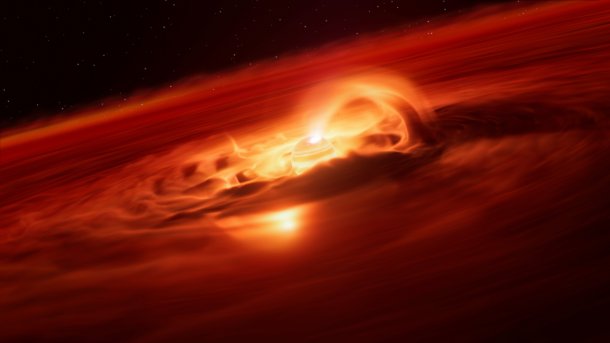
Artistic representation of the growth spurt
(Image: ESO/L. Calçada/M. Kornmesser)
Using the Very Large Telescope (VLT) of the European Southern Observatory (ESO), an international research group has discovered a planet without a star that is growing at a speed that has never been observed before. The celestial body devours a total of six billion tons of gas and dust per second, which is twice the size of Lake Starnberg. The exoplanet with the designation Cha 1107-7626, which is 620 light years away from us, also behaves like a star in various other ways, which makes it particularly interesting for researchers. The team points out that the formation of such “loner planets” is still unclear.
Empfohlener redaktioneller Inhalt
Mit Ihrer Zustimmung wird hier ein externes Video (TargetVideo GmbH) geladen.
Ich bin damit einverstanden, dass mir externe Inhalte angezeigt werden. Damit können personenbezogene Daten an Drittplattformen (TargetVideo GmbH) übermittelt werden. Mehr dazu in unserer Datenschutzerklärung.
According to the ESO, the starless planet is surrounded by a disc of dust and gas, from which material constantly falls onto the celestial body. This process is called accretion and is known from black holes, for example. In the case of Cha 1107-7626, this process does not take place evenly; in August, the planet devoured material eight times faster than just months before, the research group discovered. This is the strongest accretion event ever observed in an object with a planetary mass, explains study leader Víctor Almendros-Abad from the Astronomical Observatory of Palermo. Overall, the free-floating planet is therefore around five to ten times the size of Jupiter.
A planet that behaves like a star
The discovery of the immense growth of Cha 1107-7626 blurs the boundary between stars and planets, says astronomer Belinda Damian, who worked on the study. Her team has also determined that the magnetic activity of the lonely planet plays a role in its growth. This phenomenon had previously only been observed in stars. The chemical composition of the disc around the planet also changed in the course of the observation; hydrogen was only detectable during the growth spurt. This is also a process that was previously only known from stars.
Videos by heise
“The idea that an object of planetary mass can behave like a star is simply overwhelming,” says ESO astronomer Amelia Bayo, categorizing the significance of the find. It is an invitation to ask what alien worlds look like in their earliest stages of development. While many people imagine other planets to be quiet and stable worlds, Cha 1107-7626 shows “that celestial bodies of planetary mass floating freely in space can certainly be exciting places,” adds Almendros-Abad. He and his team have now presented their research in the Astrophysical Journal Letters.



(mho)

