


Athena1 becomes Europe's first defense processor
The European processor Rhea1 gets a brother. Athena1 is intended for governments, the defence industry and aviation.
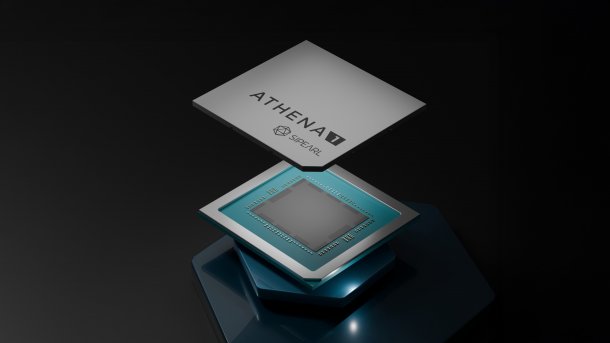
Render image of Athena1.
(Image: SiPearl)
Governments and manufacturers in the EU will be able to purchase the European processor Athena1 from the second half of 2027. The French chip designer SiPearl is designing it as part of the European Processor Initiative (EPI).
Athena1 apparently uses the identical or largely identical CPU die as the previously announced Rhea1. At its heart are 80 ARM cores of the Neoverse V1 type, but in the Athena1 without fast high-bandwidth memory (HBM2e) directly on the CPU carrier. The processor is therefore reliant on DDR5 memory. This design makes the CPU cheaper.
Also for the defense industry
SiPearl names three fields of application: Government, defence industry and aerospace (aerospace). A short presentation video explicitly shows combat equipment as an area of application. It is the first model for this purpose.
Especially in the defense industry and aerospace, the old technology is not a problem: performance is of secondary importance, reliability is much more important, especially in different environmental conditions (temperature, humidity, radiation). The Neoverse V1 cores date back to 2022, while the targeted 7-nanometre production process dates back to before 2020. In addition to an 80-core version, there are also variants with 64, 48, 32 and 16 CPU cores.
Videos by heise
The Taiwanese chip contract manufacturer TSMC produces both Rhea1 and Athena1 – there is no European alternative with a suitable manufacturing process. It is unclear whether the Athena1 chip design differs from Rhea1, for example to better harden the processor against environmental influences.
TSMC is initially also responsible for the further processing of the chips, i.e. placing them on their carriers (packaging), among other things. SiPearl intends to bring the packaging to Europe at a later date to strengthen the local industry.


(mma)


