


OpenAI Dev Days: An ecosystem around ChatGPT
OpenAI brings apps to ChatGPT and wants to be nothing less than the new Internet. However, this is only possible with developers.
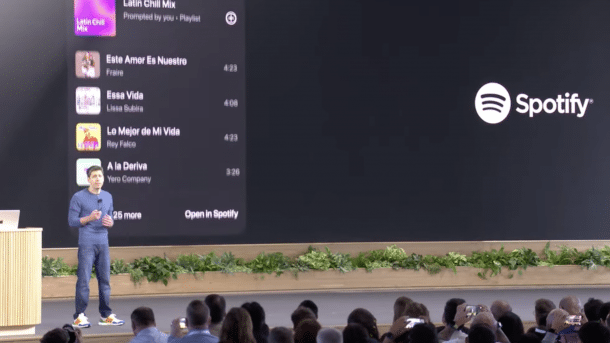
Sam Altman at the Dev Days.
(Image: Screenshot OpenAI)
In the future, companies will be able to develop and provide apps for ChatGPT. It is OpenAI's next attempt to create an ecosystem that people no longer have to leave for their digital lives. The first partners named at the OpenAI Dev Days include Spotify, Canva, Booking.com, OpenTable, Uber, and Zillow. The latter service is a property platform that is the first to be available in ChatGPT, with others soon to follow. The initial launch is planned for the USA, but it will be a while before apps can be integrated in the EU.
Developers using the ChatGPT SDK can set tags in their apps to complete a task. Users communicate the task in the ChatGPT interface. There they can also add context or ask for advice, which is also implemented. For example, ChatGPT can compile a playlist for a specific mood or occasion on request and play it directly from Spotify. In a demo, an OpenAI employee showed how to describe a poster in ChatGPT, which is implemented by Canva.
Videos by heise
OpenAI had already launched similar projects with extensions and GPTs. Other services were also to be served via ChatGPT. With improvements to the chatbot and agent capabilities, the scope of what is possible is now expanding significantly. However, it is almost always the same suspects that are on board right from the start. OpenTable has taken every opportunity to offer the service for reserving a table in a restaurant in ways besides its website and app. In addition to OpenAI, for example, also via Google's AI assistant when it was still called Bard.
Searching, shopping, and buying via ChatGPT
OpenAI's endeavor to provide people with comprehensive digital services is also reflected in the recently introduced function for paying directly via ChatGPT. You no longer have to leave the chatbot to shop. You just ask it for the best product in a certain category, and it makes a direct purchase. Online retailers then have an advantage in case of doubt due to the fast availability; nobody has to create a new account, and ChatGPT can (at least in theory) take care of all this for you. However, there is no need to visit a website and the associated advertising opportunities for other products. Etsy is already available in the USA. More shops are to follow.

With the update of the Sora video generator to version 2, the associated social network has also been expanded. Sora already came with a feed in which AI-generated videos were shown. These could be shared and used as inspiration. Now there is an iOS app called Sora, which allows you to remix videos from other users, exchange ideas, and, of course, create and share videos. Cameos allow you to integrate yourself into recordings. The Sora app is also initially only available in the USA and Canada via a waiting list.
Meta recently introduced Vibes, a feed for AI-generated videos. They can be discovered in the Meta AI app and are therefore already available to everyone.
OpenAI also presented a new AgentKit and an API for Sora 2 at the Dev Days, while Codex is getting Slack integration and an SDK. Another new feature is a smaller voice model, which should be 70 percent cheaper than the previous large gpt-realtime, as well as a smaller gpt-image-1-mini, which should save as much as 80 percent compared to its predecessor.


(emw)

