Numbers, please! The punch card: 80 characters pointing the way to EDP
Herman Hollerith's punch card machine not only ushered in the computerised age, but also laid the foundation for IBM and the derived 80-character standard.
The punch card, the first way to program a machine, turned 300 this year. The first semi-automatic loom was created in Lyon as early as 1725. To commemorate this, we have taken the liberty of updating an older “Zahlen, bitte!” and republishing it as “Zahlen, bitte! Classic”. We hope you enjoy reading it!
Continue after ad
Punch card control was already known in the 18th century. In 1725, the French inventor Basile Bouchon (also called Boachon in some sources) created the first semi-automatic loom with hole control, still using punched continuous paper.
In this section, we present amazing, impressive, informative and funny figures ("Zahlen") from the fields of IT, science, art, business, politics and, of course, mathematics every Tuesday.
The wordplay "Zahlen, bitte!" for a section about numbers is based on the ambiguity of the German word "Zahlen." On one hand, "Zahlen" can be understood as a noun in the sense of digits and numerical values, which fits the theme of the section. On the other hand, the phrase "Zahlen, bitte!" is reminiscent of a waiter's request in a restaurant or bar when they are asked to bring the bill. Through this association, the section acquires a playful and slightly humorous undertone that catches the readers' attention and makes them curious about the presented numbers and facts.
In 1805, the French inventor Joseph-Marie Jacquard took up the ideas of his predecessors, improved them, and invented the first fully automatic, programmable loom with punched card control. But how did data processing develop from this?
A strenuous time at school
Herman Hollerith, born on 29 February 1860 in Buffalo as the son of a professor who had immigrated to the USA from the Palatinate, was a highly gifted but not entirely easy student. In his youth, he drove his teachers up the wall with his stubbornness and spelling difficulties.
Continue after ad
The semi-automatic loom developed by Basile Bouchon in 1725. The loom on display at the Musée des Arts et Métiers in Paris shows that the woven band was not particularly wide.
It is said that at the age of nine, he escaped from school via the window because of an upcoming dictation and that his wealthy parents then decided to give him private lessons for the rest of his school years. This decision suited his talent for scientific subjects and numbers very well.
First inventions and patents
In 1860, Hollerith completed a degree in engineering at Columbia University's School of Mining. After graduating, he worked on an electromagnetic control system for the air brakes of railway trains, but this fell on deaf ears at the railway company. He also worked in the patent office and then, through his professor W. T. Trowbridge, joined the US Census Bureau, the statistical office of the USA. Hollerith was confronted with the 1880 census, in which data sheets on every US citizen, each with over 200 characteristics, were painstakingly analyzed by employees over a period of seven years.
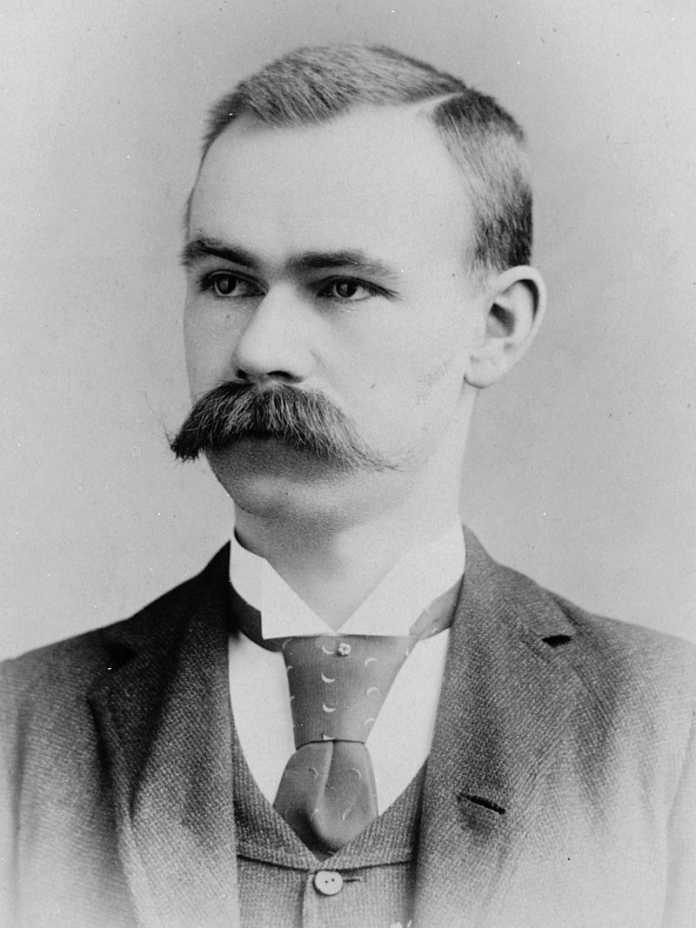
Portrait photograph by Herman Hollerith, taken around 1888.
(Image: Charles Milton Bell)
A conversation with John Shaw Billings, who was responsible for mortality statistics at the Census Bureau, gave Hollerith the idea of developing a machine that could automatically analyze such data. Hollerith learned the crucial technical trick from the railway conductors: They marked the tickets in certain places to record passenger characteristics (such as gender and skin color), which was intended to make possible ticket misuse more difficult.
Data capture through punched holes
He adopted this principle in his punched cards. The difference to the punched card system in looms was that he introduced electrical scanning, and the punched cards did not directly control a mechanical system but processed information. Various types of numerical information were stored in pre-printed, standardized cards by punching holes in them. In binary terms, a punched hole corresponded to a 1 (closed circuit), and no hole corresponded to a 0 (open circuit). And these current pulses were read out and counted by the machine.
The first punched card variant around 1890 with theoretically up to 12x24 = 288 hole variations. The card was about the same size as a 1 dollar note at the time. The corners were rounded to be less sensitive to friction and a piece was missing at the bottom right for reasons of fit. Later punched cards had this corner at the top left.
(Image: Markus Will)
The punch card system consisted of a tabulating machine, punch card puncher, punch card reader, and punch card sorter. Hollerith applied for a patent for the system, which was granted as patent US 395,782 [PDF] on 8 January 1889.
Enormous success through automated data capture
Hollerith demonstrated the superiority of his method in a census competition, in which he counted four districts of St. Louis in just five and a half hours, compared to 48 hours for his competitor. He was therefore commissioned to assist with the census, which was carried out on 2 June 1890.
And although the population of the USA had increased by 12.8 million inhabitants (or over 25%) to 63 million compared to the previous census, the results of the 43 Hollerith machines involved were already available in December of the same year. In contrast, it took several years to analyze the previous 1880 census.
Empfohlener redaktioneller Inhalt
Mit Ihrer Zustimmung wird hier ein externes YouTube-Video (Google Ireland Limited) geladen.
Ich bin damit einverstanden, dass mir externe Inhalte angezeigt werden.
Damit können personenbezogene Daten an Drittplattformen (Google Ireland Limited) übermittelt werden.
Mehr dazu in unserer
Datenschutzerklärung.
Further development of the business idea
Hollerith had not only considerably shortened the analysis time, saving the US government USD 5 million, but had also laid the foundations for electronic data processing. He turned this into a business model: while he did not sell the machines themselves but rented them out to states on favorable terms, he generated most of his income by selling the (disposable) punch cards. It is said that he was able to produce 1000 pieces at thirty cents and sell them for one dollar.
In 1896, he founded the Tabulating Machine Company (TMC) for this purpose. Rentals for censuses in Austria and Russia and other countries followed. Further subsidiaries were also founded. The local subsidiary Deutsche Hollerith-Maschinen Gesellschaft mbH (DEHOMAG) was founded in 1910.
Hollerith's withdrawal
However, Hollerith preferred to tinker instead of marketing the product worldwide. He was also considered a difficult character due to his irascibility. His network of worldwide license companies was also difficult to manage. He therefore sold TMC to the businessman Charles Flint in 1911 and gradually withdrew from the business. He remained as a consulting engineer with dwindling influence, lived on his ranch, and died of heart failure in 1929.
The company, operating under the name Computing-Tabulating-Recording Company (C-T-R), added other product areas such as clocks and scales to the punched cards. In 1924, the company, which by then had a dominant market position in the punched card sector, became the International Business Machines Company (IBM), which was to conquer the world decades later with its personal computer systems.
80 columns derived to become the industry standard
The IBM punched cards with 80 columns, patented in 1928, not only developed into the industry standard in the punched card sector, the numerical number of which not only influenced IBM's Job Control Language (JCL) programming language but is also regarded as the origin of the maximum width of 80 characters in various terminals or e-mail systems.
Many companies had entire “Hollerith departments.” New developments such as magnetic tape from 1940 and the floppy disc from 1971 gradually replaced the punched card as a storage medium due to its enormously higher capacity.
Punch card IBM standard with 80 columns.
(Image: Fa. Gizeh)
IBM and the Nazi era
The standardized recording of the population using punched cards also led to what was probably the darkest chapter in IBM's history. With its European subsidiaries, such as the German DEHOMAG, IBM also made profits during the Nazi era –, among other things by recording camp inmates in the concentration camps. And after the invasion of the Netherlands in 1940, comprehensive population registers of all Dutch Jews existed thanks to the census recorded with Hollerith systems. Identification and deportation was therefore no problem.