


Biodegradable printed circuit board made of cellulose
Cellulose residues, which have hardly been used to date, can be pressed into hard circuit boards after “hornification.” They don't have to be totally waterproof.
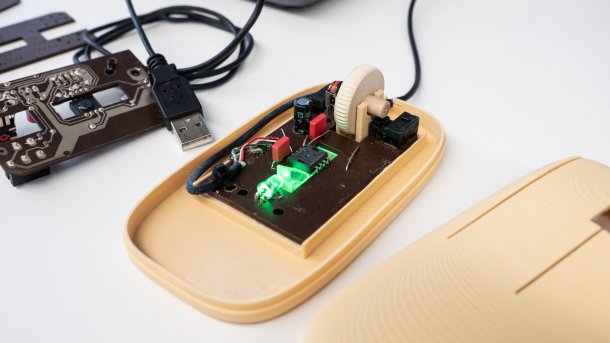
Prototype of a largely biodegradable wooden mouse
(Image: Empa)
Printed circuit boards for electronic devices are generally made of glass fiber-reinforced epoxy resin. A major advantage is that it lasts practically forever. A major disadvantage is that it lasts practically forever. The Swiss Federal Laboratories for Materials Science and Technology (Empa) is now presenting a biodegradable alternative: "brownish lignocellulose, for which there was previously no use," as materials researcher Thomas Geiger from Empa describes it.
“Our partners at the TNO research institute in the Netherlands have developed a process to extract the raw materials lignin and hemicellulose from the wood,” explains Geiger. He grinds the remaining residual material, which still contains a little lignin, with water to break down the relatively thick cellulose fibers into fine cellulose fibrils. This creates a fine network of wafer-thin fibrils that are linked together.

(Image: Empa)
The water is then pressed out. The fibrils move closer together and finally dry into a solid mass. The researchers call this process “hornification.” The lignin contained serves as an additional binding agent.
The result is a “hornified board” that is almost as resistant as a conventional printed circuit board. But only almost, which is the goal. After all, the board is supposed to be compostable. It must therefore react to water or high humidity. “If water can no longer penetrate the carrier material, microorganisms such as fungi can no longer grow in it—and this would mean that it is no longer biodegradable,” explains Geiger.
Wooden mouse as a flagship device
In times of short-lived disposable electronics, there should be enough applications. Empas' Austrian partner Profactor, a non-university research company with sites in Steyr and Vienna, demonstrates that it works in principle. Profactor has printed hornized circuit boards with conductor tracks and fitted them with components. The result is functioning electronic devices, such as a computer mouse and an RFID card. Fittingly, the mouse was given a wooden housing.
Videos by heise
Empa describes the composting process as follows: “At the end of its service life, such a device could be composted under the right conditions. Once the carrier material has decomposed, the metal and electronic components can be removed from the compost and recycled.” For now, however, the material experts want to work on the durability of the more sustainable conductors.

(Image: Empa)
The work is part of the EU research project HyPELignum. It is striving for CO2-neutral electronics. To achieve this, project partners from research and industry are combining wood-based raw materials and transition metals that are as uncritical as possible with additive manufacturing. HyPELignum is in turn part of the Horizon Europe research framework programme.


(ds)


