


Minister of Justice: "Chat control is taboo in a constitutional state"
Federal Minister of Justice Stefanie Hubig (SPD) reaffirms her "no" to chat control. The federal government has not yet found a common line.
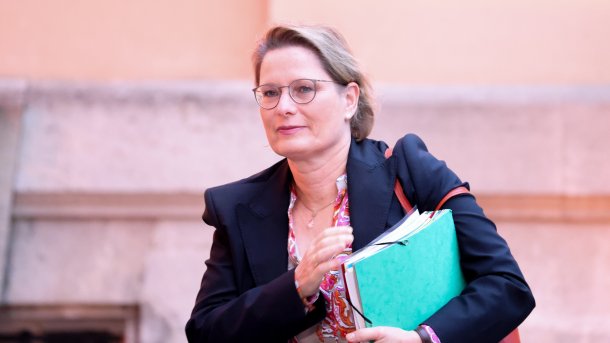
Federal Minister of Justice Stefanie Hubig (SPD) on her way to a cabinet meeting.
(Image: EUS-Nachrichten/Shutterstock.com)
After Jens Spahn, head of the CDU/CSU parliamentary group, the Federal Minister of Justice has now also clearly opposed the EU's plans for mass surveillance. "Unprovoked chat monitoring must be taboo in a constitutional state. Private communication must never be under general suspicion," said Stefanie Hubig (SPD) in Berlin on Wednesday. "The state must also not force messengers to scan messages en masse for suspicious content before they are sent."
"Germany will not agree to such proposals at EU level," emphasised the Justice Minister. "We must also make progress in the fight against child pornography at EU level. I am committed to this. But even the worst crimes do not justify sacrificing elementary civil rights. I have been insisting on this for months in the votes of the Federal Government. And it will remain so."
Federal government remains undecided
Despite the clear words of Spahn and Hubig, the Federal Government does not yet want to commit to a position – and refers to the need for further coordination. A spokesperson for the Federal Ministry of the Interior emphasised that there is no agreement within the federal government. So far, Germany has strictly rejected the EU plans.
This makes it increasingly likely that the vote in the EU Council planned for next week will be postponed. The Committee of Permanent Representatives of the Member States (Coreper) is currently meeting in Brussels to prepare for the Council meeting on 14 October. Chat control is also on the agenda.
If the representatives do not reach an agreement, the issue is likely to be resubmitted. The Federal Ministry of the Interior also expects that a decision will not be made until the Council meeting in mid-December at the earliest. Chat control failed in the Council a year ago, partly due to German opposition at the time.

A government spokesperson said in Berlin on Wednesday that, from the perspective of the German government, technical difficulties still needed to be clarified and regretted that the debate had taken a "turn for the worse". Unprovoked chat control had always been a taboo. "We are concerned with preventing and combating the sexual abuse of children and not with chat control."
The EU Commission also rejects the criticism of the project. A Commission spokesperson stated that "no general monitoring" of online communication is planned.
Videos by heise
Fierce opposition to surveillance
In fact, the EU's plan, which has been hotly contested since 2022, envisages using applications on users' end devices to access the content of messengers before it is encrypted (client side scanning). Images, videos, and URLs are to be automatically checked for child abuse material. Text messages are excluded.
Critics see this as mass surveillance that violates fundamental rights. The operators of encrypted messenger platforms are also opposed to the plan. Signal CEO Meredith Whitaker announced that she would withdraw the messenger from the European market if the policy "undermines our encryption and data protection guarantees".
Data protectionists have criticised the measure as a massive invasion of privacy. "Chat control does not help to achieve the undoubtedly supportable goal of combating child pornography," says Federal Data Protection Commissioner Louisa Specht-Riemenschneider. "The impact on all of us and our private communication, on the other hand, is massive and therefore hardly justifiable."


(vbr)

