


Waiting for AI Mode – and fearing the effects
The new AI mode in Google's search was announced for Wednesday, but the rollout is taking time. The EU needs patience. And nerves.
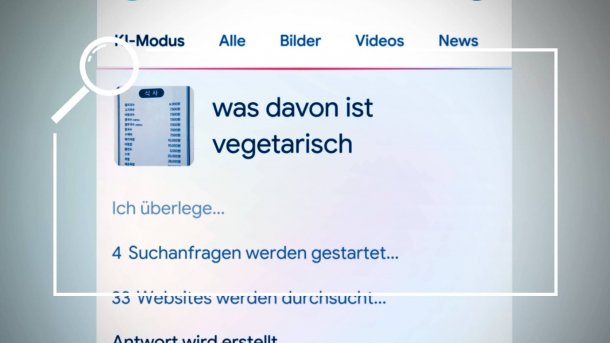
AI Mode translates Korean menu.
(Image: Google)
Not everyone is keen on the new AI Mode in Google Search. The announcement that it is now being made available in Germany, Austria, Switzerland, and other countries is quickly followed by comments that want to know in advance how to switch it off. But there is no need to do so yet. Google says that the rollout of AI mode is underway but could take a few days.
When the time comes, AI Mode will not appear automatically, like the AI overviews that often appear above the link lists. Google decides when you see AI overviews. It depends on the query. Many Google queries are in fact very simple questions about a URL. For example, you enter the name of a shop or a media company without completing the URL itself—simply use the link from the Google list. AI overviews tend to appear when you ask a “What is…?” question. Google already uses the data from the real-time search as well as its database, the Knowledge Graph, in which millions of pieces of information are stored. Both are also combined for AI Mode.

(Image: Google)
AI Mode corresponds to a chat
In contrast, AI Mode can be found in a separate tab, if it is there. It is more like a chatbot such as ChatGPT, Perplexity, or even Google's own Gemini. Questions asked in AI Mode should be able to be even more complex than, for example, a question to the AI overview. As Google repeatedly emphasizes, it is also about being able to delve deeper into a topic. Part of this is that images can also be used in AI mode. You can also have a kind of conversation with the search, i.e., ask questions about an aspect of the answer.
Google also says that questions asked in AI mode didn't really exist before. Google would not have been able to answer them. This should reassure some website operators. They are worried about the number of visitors and their advertising revenue.

From BERT to AI Mode
In the beginning, Google only searched for keywords in queries and then searched for suitable websites. Since around 2020, Google has increasingly been using AI as we know it today, specifically the language understanding system BERT. This stands for Bidirectional Encoder Representations from Transformers and is a technique for training language models. With it, search has learned to better capture contexts, i.e., it no longer just searches for a keyword in a sentence.
Videos by heise
While Google's search can now understand questions even better, initially thanks to the AI model Bard and now thanks to a search-optimized version of Gemini, the output has also changed significantly with AI Overviews. AI Mode will do this once again. This in turn will have an impact on the internet. Because Google uses content from website operators.
When Google introduced the so-called position zero and featured snippets, this already had a similar impact on content creators. These are the direct answers and extracts from websites that Google displays above the link lists and in a block with matching questions. If you get an answer to a question such as how to delete your Instagram account, you no longer have to visit a website where this is explained.
Website operators are therefore once again concerned that there will be a massive drop in visitors and clicks. Initial data analyses from the USA, where AI Mode is already available, speak of up to 25 percent fewer visitors. So far, Google has not provided any form of compensation for this. Perplexity, on the other hand, is planning a new payment system for the utilization of content; Microsoft once announced that it wanted to give website operators a share of advertising revenue from Bing, and OpenAI is trying to appease publishers with selected partnerships.
Google says that the losses will hardly be measurable. One reason is that the questions that can be asked in AI Mode could not have been asked before. This increases the overall number of Google queries. In addition, the quality of visits to increases, but this can neither be verified nor monetized. Of course, not every question is suitable for AI Mode, and the existing search will remain. But we will see how much overlap there will be when AI Mode is finally really there.


(emw)


