


Intelligence Chiefs: "We are already in the fire"
Once a year, the three German intelligence services appear in a public session before the Parliamentary Control Committee. They bring many wishes.
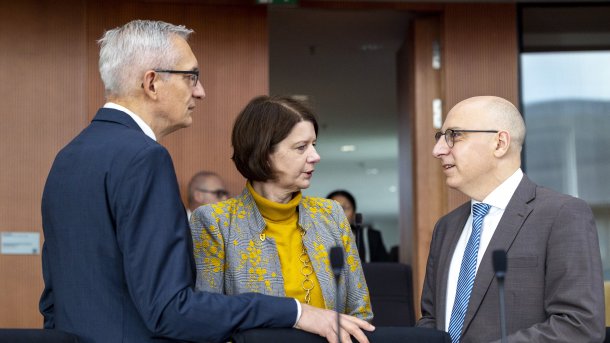
Before the hearing on Monday in Berlin: President of the Federal Intelligence Service, Martin Jäger, President of the Federal Office for the Military Counterintelligence Service, Martina Rosenberg, and President of the Federal Office for the Protection of the Constitution, Sinan Selen (from left to right).
(Image: Bundestag / Sebastian Rau / photothek)
Martin Jäger has only been in office as the new President of the Federal Intelligence Service (BND) for a few days. He is already a central figure in the public hearing of the Parliamentary Control Committee for Intelligence Services (PKGr) of the Bundestag on Monday in Berlin. Jäger knows many facets of politics; he was most recently ambassador to Ukraine. Now he is to lead the Federal Republic's foreign intelligence service at a time primarily shaped by Russia's actions. He therefore describes the situation as no longer a war, but also no longer true peace: "We are already in the fire."
New BND Chief Wants More Powers
The service, which has the license for the Federal Republic of Germany to scout and eavesdrop abroad, but not to kill, must adhere to law and order. And – see NSA affair – has not always succeeded in the past as its clients from the federal government and parliament would have liked. These very questions are now back on the table. Because the BND, after all the intelligence service of the largest EU state, sees an urgent need to revise its capabilities. The "traffic light" coalition already wanted to further reform the intelligence service law.
Sinan Selen would also like more powers, as he explains in the Bundestag on Monday morning. The previous Vice-President of the Federal Office for the Protection of the Constitution (BfV) has years of experience, including responsibility for counter-intelligence, extremism, and cyber issues at the Cologne-based domestic intelligence service. The picture of reality he paints is partly quite bleak: "Russia is literally crossing extremely dangerous borders," he describes, referring to incendiary devices in air cargo. And says: "It is happening, we can see it, and we must not allow it."
Looking East, Worries in the West
The situation in which the German intelligence services operate is complicated. On the one hand, this is not a topic in the public hearing in the Bundestag, but the question remains how reliable the partner services in the USA will remain under their new leadership. On the other hand, there are Russia's actions. If Germany permanently deploys a combat brigade of the Bundeswehr to Lithuania, then, in addition to the BND, the Military Counterintelligence Service must also identify and, if possible, prevent potential dangers. It is a kind of constitutional protection for the Bundeswehr. Its President Martina Rosenberg describes a whole range of challenges facing the German military: acts of sabotage, disinformation campaigns, drone overflights of military facilities. All of this is causing uncertainty in Europe, says the President of the MAD. Cyberattacks on military networks are also repeatedly observed, aiming to impair operational readiness.
The members of the control committee from the CDU, CSU, SPD, and Greens – parliament has not yet elected representatives from the Left Party and AfD to the committee. They also used the hearing to publicly explore the presidents' opinions on the planned further reform of intelligence service law. And there are a whole host of demands.
While the responsibilities of the services among themselves are relatively clearly defined, all three complain this morning about the challenges they face – partly because their counterparts do not adhere to rules or even deliberately circumvent them. "Russia has not forgotten the Cold War," states BfV President Sinan Selen, and concludes: "The instruments used at the time are still available and continue to be used." This includes all variants of influence, for example, also in the criminal milieu, which is already evident in cyberattacks.
Office for the Protection of the Constitution Wants to Tighter Control Platforms
But other actors, such as extremists, also cross all boundaries, and technology even helps them. People who are in a "very fluid opinion-forming process," often young people, are "bombarded with these narratives," describes Selen. The algorithms used to maximize advertising revenue lead to radicalization processes within weeks or months from initial contact to the decision to commit an act.
Younger and younger people are being targeted – by extremists, but also by foreign powers. One conclusion of the President of the Office for the Protection of the Constitution: different legal provisions are needed. Firstly, regarding the disclosure obligations of providers, concerning speed and response times, which may even have to be enforced if necessary. Secondly, to compel platform operators to suppress radicalizing content if necessary. They also play a central role in disinformation. "We try to prevent further dissemination at an early stage with platform providers when we can attribute state influence," describes Selen – this usually also violates their terms and conditions.
Videos by heise
AI: Haystack Heuristics in Gold Rush
Especially the interfaces to other services are a problem from the perspective of the services. The BND considers its offering to its partners not relevant enough: "This is not a diplomatic circle, but something based on reciprocity. You receive information because you can pass on information," said BND President Martin Jäger. The BND must therefore be able to generate more valuable information. BfV President Sinan Selen also argued fundamentally in a similar way. Different legal frameworks between European partners have so far often been a hurdle, both in terms of data and operational cooperation, for example in cyber defense issues.
"We have an enormous amount of data," described Martin Jäger in the session. "What we are doing now is pooling data from numerous procurement methods and then evaluating it with AI models. And this has already begun." However, only on a trial basis; regular operation must be approved by the Chancellery as the supervisory authority. Both Selen and Jäger immediately dismissed the idea that AI could save personnel in the services – it only changes the required profile.
However, Jäger hopes for significantly improved findings if own data from human and technical reconnaissance can be jointly analyzed with that of third parties: "But this only makes sense, of course, if we can retain this data for a period of time. Especially the data we receive from partners, because we don't know what gold nuggets are contained in our data if we don't have the technical capabilities." The merging of structured and unstructured data is a prerequisite for a comprehensive picture, explained BfV head Sinan Selen from the domestic intelligence service perspective. Often, only a retrospective view allows for the recognition of network structures, i.e., the analysis of older data. Here, both also see a need for legal action. When the CDU, CSU, and SPD federal government will present its plans, is still open.
However, when using large data collections, the BND, BfV, and MAD encounter another obstacle: often, they must keep their distance from AWS, Azure, and similar cloud providers and market-standard AI cloud service providers, even if they were used where possible. He could only recommend that own, European capabilities should be expanded. "We are also observing this discussion with other European partners," explained Selen.



(vbr)

