


Starship V2 completes successful final test flight
The final test flight of Starship V2 lasted one hour and was largely trouble-free. The spacecraft deployed satellite dummies along the way.
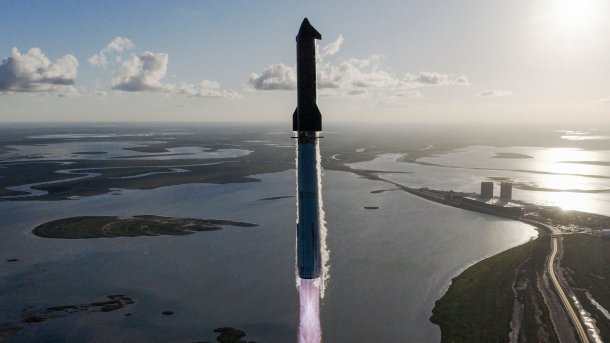
Launch of Starship on October 13, 2025
(Image: SpaceX)
Last launch for the second generation Starship: The eleventh flight of Starship largely went according to plan and was a success, according to the US space company SpaceX.
The Starship with the Super Heavy booster launched from SpaceX's own launch site, Starbase, in the US state of Texas on October 13 at 6:23 PM local time (October 14, 1:23 AM our time). It was the last flight of the second generation of Starship and the first generation of the “Super Heavy” booster, SpaceX announced.
The upper stage separated from the Super Heavy booster as planned over the Gulf of Mexico and continued after its Raptor engine ignited.
Starship splashed down in the Indian Ocean
Starship entered Earth's atmosphere over the Indian Ocean. It then performed a descent maneuver and splashed down in the designated area in the Indian Ocean. Along the way, it deployed eight dummy Starlink satellites. The flight, during which Starship did not ascend into Earth orbit, lasted about an hour.

The reusable Super Heavy booster, which had already flown in March, splashed down in the Gulf of Mexico off the coast of Texas about ten minutes after launch. SpaceX reported that an error occurred during the first firing of the Raptor engines after separation: instead of the planned 13, only 12 engines ignited. However, all 13 engines could be activated during the braking maneuver shortly before entering the sea.
For the next flight, SpaceX has announced a new version of Starship and Super Heavy. Several new vehicles are currently being built. Starship V3 is expected to be ready for use next year.
Videos by heise
Starship is intended to reach orbit
For the first time, it is intended to carry out orbital flights and transport real payloads. SpaceX also wants to test refueling Starship in space -- this is a prerequisite for missions further into the solar system, for example, to Mars.
Starship is currently the largest rocket. It consists of the approximately 70-meter-long “Super Heavy” booster and an approximately 50-meter-long upper stage. Both are intended to be reused after returning to Earth.
Starship is intended to be used for future flights to the Moon. SpaceX also wants to fly to Mars with it. In April 2023, a Starship took off for the first time and exploded after a few minutes. After various failures, the eleventh was the second successful flight in a row.


(wpl)

