

Mercedes-Benz Vision Iconic: PV paint to supply power for 12.000 km per year
With a study, Mercedes shows how things will proceed in the luxury class. More exciting than the spectacular design is the outlook on the technology.
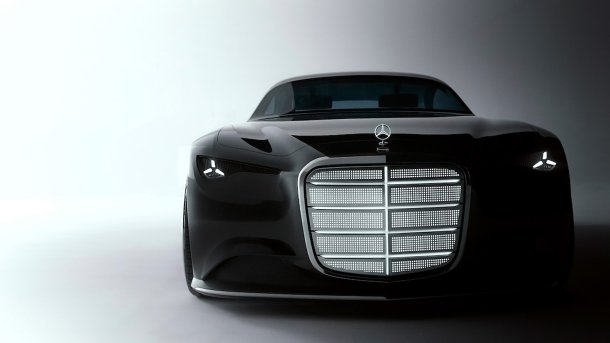
(Image: Mercedes-Benz)
The dual strategy has failed: Mercedes wanted to establish combustion engines and electric drives in parallel on their own platforms in the luxury class. However, even though a Mercedes EQS drives very convincingly, even a minor facelift could not help it achieve the sales figures that the strategists had hoped for. With the Vision Iconic study, Mercedes wants to provide an outlook on the future direction in this segment.
No Production Model
The design is unusual and is unlikely to make it into series production in many aspects. The radiator grille, which the GLC EQ presented at the IAA already features in a very similar form, probably has a good chance. The huge wheels with the flat rubber ring, and especially the absurdly long distance between the front wheel and the door, as well as the extremely low ground clearance, are a designer's plaything that is unlikely to be available for purchase. Of course, the interior with blue plush, the four-spoke steering wheel in the 1930s look, and a massive glass cigar are also maximally distant from a production model.
PV Paint
It gets more exciting technically, especially since Mercedes only indirectly addresses the drive of the study. The idea of equipping cars with solar panels, which is tempting at first glance, is anything but new – and not exactly successful so far either. Mercedes wants to finally bring about a breakthrough with a novel paint that integrates PV elements. On an 11 m² surface, based on the location of Stuttgart, driving energy for up to 12.000 km per year could be captured. This value, of course, only applies under ideal conditions and refers to consumption in WLTP. But even if it were only a third of the promised mileage in practice – why should one actually let that pass?
Manufacturers and legislators have been approaching the topic of autonomous driving for several years now. By the end of the current decade, Level 4 should at least have been achieved in the luxury class. This would mean: In at least (!) one precisely described scenario, the car can handle all situations on its own. Of course, manufacturers are free to describe this scenario precisely, as they are liable in the event of an accident. On the other hand, no one forces them to enable this automated driving in only one scenario. Mercedes announces Level 4 with the study in two areas: on the highway and when parking.
Videos by heise
Power Consumption for Assistance
Such things require considerable computing power, which in turn requires a certain amount of electricity – and thus limits the range of electric cars. Not only Mercedes is therefore researching artificial neural networks. "Neuromorphic Computing" is intended to mimic the functioning of the human brain. The goal is to reduce the energy demand behind artificial intelligence. Mercedes expects that the electricity demand, for example for automated driving, will be 90 percent lower with "Neuromorphic Computing" than with current chips.

(mfz)