


Pinterest without AI Slop – Feed almost without AI content
Following complaints: People should decide on Pinterest how much AI content they want to see and, above all, not see.
(Image: Pinterest)
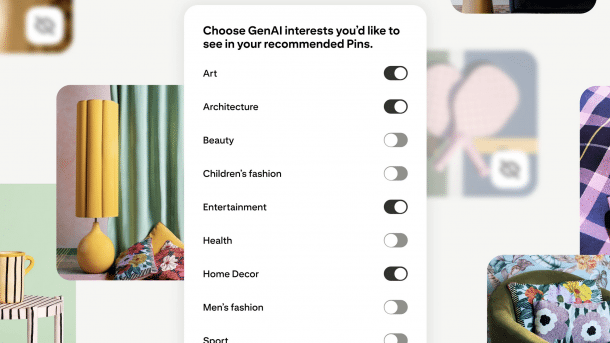
According to Pinterest, 57 percent of the internet is already AI-generated. And people are apparently not happy about it. At least, complaints at Pinterest are said to have increased significantly, so a feature is now being introduced that allows users to decide how much AI content they want to see. However, it cannot be completely switched off.
The problem is that people on Pinterest, in particular, are looking for content such as craft instructions, decoration and design, or products that they can actually buy. AI-generated cats made from mandarins or other uncraftable tips, as well as knitting patterns, floral arrangements for weddings, and wallpapers that cannot possibly exist, are not well received. Pinterest is also concerned with content that can affect users' well-being—for example, in the area of beauty. A lot of work is done here with AI-generated models.
AI labels and Customizable Content
Such AI slop, meaning AI garbage, can be found on all platforms on the internet. Pinterest wants to maintain balance and wants to maintain the balance with the new setting options. Thus, it is not possible to hide all AI content. These cannot always be recognized either, so there can be no guarantee. However, Pinterest already introduced an AI label a short time ago, which is intended to mark AI content.
Videos by heise
Nevertheless, the platform also wants to allow AI innovation. Of course, there is also AI-generated content that is considered less annoying and even exciting. Currently, this includes, for example, videos in which knives cut through supposed glass objects. Or babies whose mouths are filled with foreign words.
Initially, AI settings can be changed on Android devices and on the desktop. iOS is expected to follow in a few weeks. To see less AI content, you need to change the setting for “Suggestions.” There, you can specify for different categories individually that less AI content should be displayed. Alternatively, you can also make changes via the three-dot menu for individual images.
AI labels also exist on other platforms. However, there is still no way to exclude AI content altogether. On Instagram, for example, you select content that does not interest you, so the algorithm learns—if in doubt, also—that you do not want to see certain AI content. TikTok learns more through user behavior.



(emw)

