


Banana Pi BPI-R4 Pro: High-End Mainboard for DIY Routers
Plenty of fast Ethernet, SSD slots, and Wi-Fi 7 support: The Banana Pi BPI-R4 Pro is richly equipped.

(Image: Sinovoip / Banana Pi)
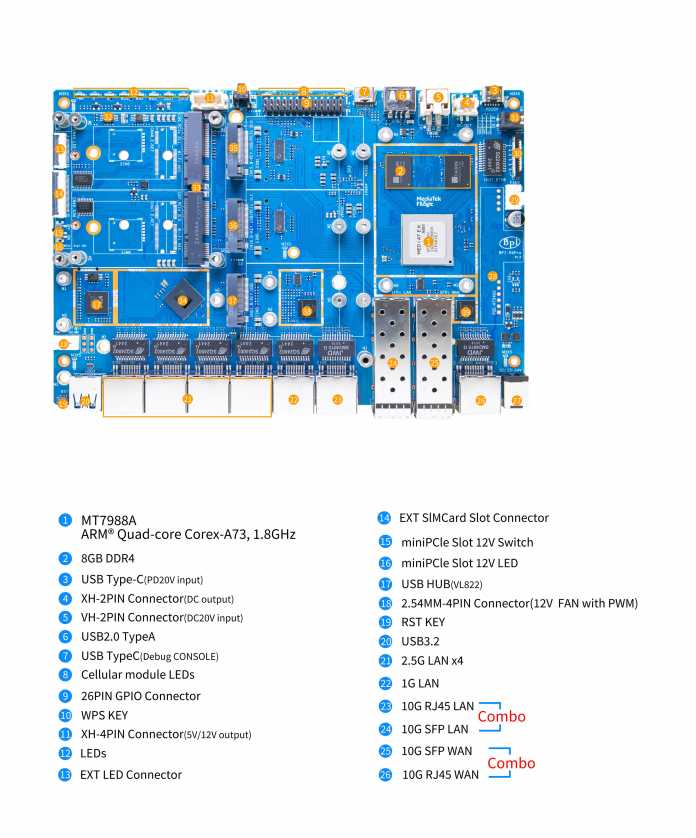
The Chinese manufacturer Sinovoip is selling its most richly equipped router mainboard to date, the Banana Pi BPI-R4 Pro. At its core is a fast processor from Mediatek for router standards: The MT7988A, also known as Filogic 880, integrates four ARM Cortex-A73 cores, flanked by 8 GB of DDR4 RAM. This makes the board suitable for DIY flash NAS, for example, as a multimedia hub.
Plenty of Ethernet and SFP+
The Mediatek processor connects numerous additional chips via PCI Express and USB. Two slots in Small Form-Factor Pluggable (SFP+) format accommodate fiber optic and Ethernet modules and transmit up to 10 Gbit/s. Two RJ45 sockets are also designed for up to 10 Gbit/s. These are combined connections behind two network controllers; thus, one port can be used from each RJ45-SFP+ pair.
One port each can connect to a preceding modem via WAN (Wide Area Network). For further cabling, there are four 2.5 Gbit/s ports and one Gigabit Ethernet port. The ports are behind several network controllers: two Aeonsemi AS21010P and one Maxlinear MxL86252C.
Komponenten des Banana Pi BPI-R4 Pro (2 Bilder)
Sinovoip / Banana Pi
)Wi-Fi 7, Mobile Communications, and SSDs
There are two Mini-PCIe slots for WLAN modules. Sinovoip itself offers the BPI-R4-NIC-BE14 a Wi-Fi 7 module that uses both Mini-PCIe slots. It supports all three Wi-Fi bands 2.4, 5, and 6 GHz simultaneously, the latter with the maximum possible channel width of 320 MHz.
Three M.2 slots in B-Key format accommodate mobile communication modules for 4G or 5G. Correspondingly, there are three Nano-SIM slots for separate mobile tariffs. On the back of the board are two M.2-M-Key slots for NVMe SSDs. A total of two PCIe 3.0 lanes are available for two M- and B-Key slots each – so a maximum of two out of four slots can be used simultaneously. The third B-Key slot is connected via USB.
One PCIe 3.0 lane is sufficient for almost one gigabyte per second. This is enough for SSDs in a router or NAS.
For an operating system and firmware, 256 MB of SPI NAND flash and 8 GB of eMMC flash memory are also soldered on. Alternatively to an SSD, the storage can be expanded via microSD card. Additionally, there is one USB 2.0 and one USB 3.2 Gen 1 (formerly USB 3.0) port each. A USB Type-C port is used for debugging. The board is powered by a DC power supply with 12 or 24 volts.
The mainboard, at 194 mm × 134 mm, is significantly larger than previous Banana Pi boards and therefore requires new cases. A draft already exists.
Videos by heise
Still no OpenWrt support
OpenWrt does not yet support the Banana Pi BPI-R4 Pro according to the overview. However, since OpenWrt already runs on the previous R3 and R4 models, support for the R4 Pro version should follow.
Sinovoip sells the Banana Pi BPI-R4 Pro in its webstore for 165 US dollars, equivalent to 142 Euros. In addition, there are 38 US dollars for shipping from China via DHL and import VAT. In total, the mainboard should cost just under 210 Euros. The WLAN module BPI-R4-NIC-BE14 costs 70 US dollars, making the total package likely to be around 275 Euros.
The normal R4 version is also available from German retailers; the streamlined Lite variant hardly.
Empfohlener redaktioneller Inhalt
Mit Ihrer Zustimmung wird hier ein externer Preisvergleich (heise Preisvergleich) geladen.
Ich bin damit einverstanden, dass mir externe Inhalte angezeigt werden. Damit können personenbezogene Daten an Drittplattformen (heise Preisvergleich) übermittelt werden. Mehr dazu in unserer Datenschutzerklärung.


(mma)


