


Risk of Defect: Data Recovery Specialists advise Backups of Older WD Hard Drives
Numerous Western Digital hard drives apparently have vulnerable firmware. It becomes dangerous at the latest when clicking sounds occur.
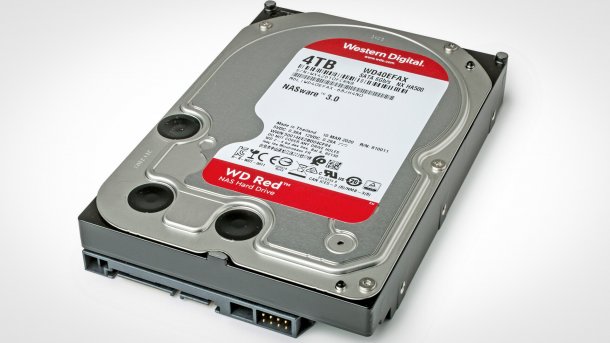
(Image: heise medien)
Some older hard drives from the manufacturer Western Digital are reportedly susceptible to failures, which are facilitated by the recording technology and firmware of the affected drives. They all have one thing in common: they rely on Shingled Magnetic Recording (SMR) technology. In this process, data tracks overlap like roof shingles to increase capacity. This, in turn, requires complex firmware that constantly logs where which data is located to position the read heads correctly. Errors can apparently occur here, ultimately leading to failure.
About the problem initially reported by 030 Datenrettung Berlin. The company names 14 affected WD hard drives with capacities from 2 to 6 TByte from the Blue, Red, and Purple series, which WD recommends for PCs, NAS, and video surveillance systems. Only the Purple models raise questions because WD, according to their statements, dispenses with SMR technology. Particularly unfortunate for previous customers: with the Red models, WD for a long time concealed the use of SMR technology.
We had the fundamental issue confirmed by two other data recovery companies: Attingo and Data Reverse.

(Image: 030 Datenrettung Berlin)
“A Self-Reinforcing Process”
According to them, the issue has been known among data recovery specialists since 2021/2022. 030 describes it in detail in a blog post: SMR hard drives use a so-called secondary translator, which logs all write operations. Overwriting a single data sector can therefore trigger around 10,000 changes in these translation tables.
“Each of these changes is a potential source of error. A power failure at the wrong moment, a slight jolt during the writing process, or even just the normal aging of the data carrier can lead to inconsistencies in the hard drive's service area and especially in the translation tables,” it states.
HDD controllers recognize inconsistencies in the tables and automatically attempt to correct them. This can become critical if, for example, a read/write head in a hard drive shows early signs of wear and occasionally delivers incorrect data.
In such a case, 030 explains: “The controller logic interprets this incorrect data as damaged translation tables and attempts to 'repair' them. However, in doing so, it overwrites correct data with incorrect 'corrections'. The result: a self-reinforcing process that increasingly corrupts the firmware until the hard drive finally fails completely.”
Videos by heise
Backups, Backups, Backups
Markus Häfele, head of the data recovery provider Attingo, explained in an interview with heise online that this is not a fundamental firmware error but a side effect of SMR technology in the affected HDDs. The failures usually announce themselves through initial read errors. However, they can also occur suddenly, for example, due to shock.
At the latest, when a hard drive starts clicking audibly, action is required. The noise is caused by corrupted firmware data, which leads to inconsistent movements of the read/write heads.
Data recovery specialists recommend backing up all data to other storage media at this point at the latest. In most cases, they can recover the data using special software, but with the affected SMR models, this is an extremely lengthy and potentially expensive process. Acelab software, for example, has a so-called technological mode that bypasses the translation layer and can copy the basic data. However, the read speed is so slow that the process can take days to weeks.
Jan Bindig, head of Data Reverse, also notes that around ten percent of the affected WD hard drives encrypt their firmware. For such models, data recovery is even more complex, if possible at all.
No fundamental problems have been known so far with SMR hard drives with higher capacities above 6 TByte. They use different platforms with completely different firmware, which apparently handles the translation layer differently.
Empfohlener redaktioneller Inhalt
Mit Ihrer Zustimmung wird hier ein externer Preisvergleich (heise Preisvergleich) geladen.
Ich bin damit einverstanden, dass mir externe Inhalte angezeigt werden. Damit können personenbezogene Daten an Drittplattformen (heise Preisvergleich) übermittelt werden. Mehr dazu in unserer Datenschutzerklärung.


(mma)


