


Landspace Prepares for First Flight of Reusable Rocket
Landspace is a pioneer in China. The space company is currently preparing the launch of the first reusable Chinese rocket.
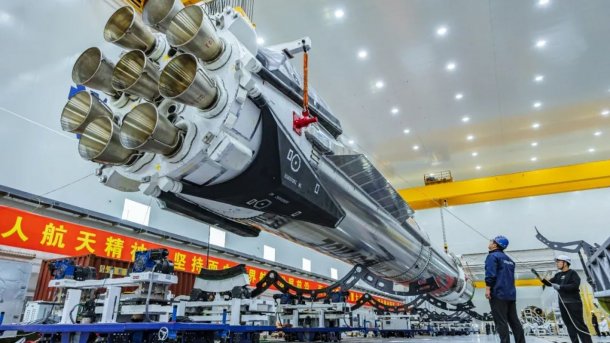
First stage of the Chinese rocket ZQ-3
(Image: Landspace)
China is now established as a spacefaring nation: the country not only sends satellites into Earth orbit but is also preparing manned missions to the moon. Only one thing has been missing so far: reusable rockets. The private Chinese space company Landspace wants to change that. It has just achieved an important milestone.
Landspace has developed the heavy-lift rocket ZhuQue-3 (ZQ-3), which is similar in dimensions to the Starship of the US space company SpaceX. Last week, Landspace successfully conducted several important tests, including a static engine test.
Empfohlener redaktioneller Inhalt
Mit Ihrer Zustimmung wird hier ein externes YouTube-Video (Google Ireland Limited) geladen.
Ich bin damit einverstanden, dass mir externe Inhalte angezeigt werden. Damit können personenbezogene Daten an Drittplattformen (Google Ireland Limited) übermittelt werden. Mehr dazu in unserer Datenschutzerklärung.
The tests took place at the Jiuquan rocket launch site in the Inner Mongolia autonomous region. There, Landspace tested the fueling of the first stage of the ZQ-3 and the firing of the engines without the rocket stage lifting off.
Phase one of the tests has thus been “successfully completed,” Landspace announced. Phase two will “primarily focus on orbital launch while simultaneously attempting to recover the first stage.” Landspace has not announced a date for the maiden flight. However, it could still happen this year.
Named after a classic Chinese constellation
The two-stage rocket ZhuQue-3 is named after the Vermilion Bird of the South, a classic Chinese constellation. In its first version, it is 66.1 meters high and has a diameter of 4.5 meters. The payload capsule has a diameter of 5.2 meters. The rocket has a launch mass of approximately 570 tons.

The first stage, which is mainly made of stainless steel and is intended to be reusable, is equipped with nine Tianque-12A engines powered by liquid oxygen (LOX) and methane (LCH4). In this configuration, the rocket is designed to carry eight tons of payload into Low Earth Orbit (LEO). If the stage is not to be reused, the payload increases to 11.8 tons.
A larger variant, the ZQ-3E, is planned, which will be 76 meters tall. It is intended to carry 18.3 tons of payload into LEO, or 21.3 tons if it is not to be reused.
Videos by heise
Landspace is the first Chinese space company to launch its rocket in 2018, albeit unsuccessfully at the time. Since 2023, it has carried out several launches with the Zhuque-2 rocket, placing satellites into LEO and sun-synchronous orbit (SSO). In 2024, Landspace successfully tested the controlled descent of a ZQ-3 for the first time.


(wpl)

