


China commissions wind-powered underwater data center
In China, the first part of a wind-powered underwater data center has been completed. It is considered the world's first commercially operated facility.
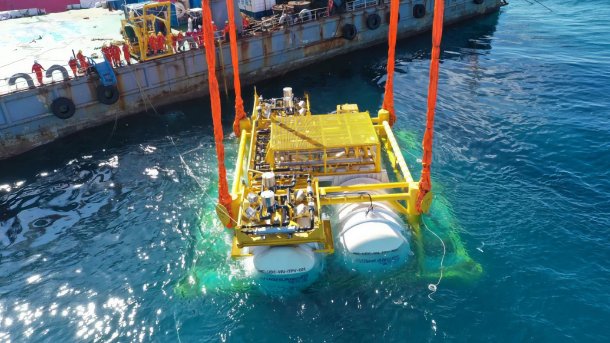
In China, the first section of an underwater data center powered by offshore wind has been completed.
(Image: Shanghai Hailanyun Technology)
In China, the first part of a wind-powered underwater data center has been completed. It is considered the world's first commercially operated facility of its kind. Initially, a 2.3-megawatt demonstration plant is being tested will be tested, before further sections are built later. In addition to wind power for energy generation, seawater will be used to cool the facility.
After complete expansion, the complex in the Lin-gang Free Trade Zone in Shanghai will have a total capacity of 24 megawatts. The total investment by the operating company Shanghai Hicloud Technology Co., Ltd. amounts to approximately 226 million US dollars, according to state information.
Many environmental benefits
The novel data center is intended to combine many environmental advantages. The aim is to reduce electricity consumption by 22.8 percent and completely eliminate the use of fresh water. Furthermore, land consumption is to be reduced by over 90 percent, which is particularly important for densely populated coastal cities like Shanghai. Over 95 percent of the power supply is to be generated by offshore wind turbines. A PUE (power usage effectiveness) value of under 1.15 is targeted; the theoretical optimum is 1.0.
Videos by heise
Shanghai Hicloud Technology Co. Ltd., founded in 2020, specializes in the construction of underwater data centers (UDCs), among other things. It expects increasing demand for data centers that have as little impact on the climate as possible, considering the AI boom.
Larger project already planned
The UDC that has now been started is intended to be just the beginning. According to Wired research, China is already planning a significantly larger project with a total capacity of 500 megawatts. However, the current project will play a significant role in testing its feasibility.


(mki)


