


SpaceX hints at "simpler" Starship after delayed moon landing plans
The schedule for the Artemis 3 mission for a crewed US moon landing can no longer be met. A simplification could speed up the process, says SpaceX.
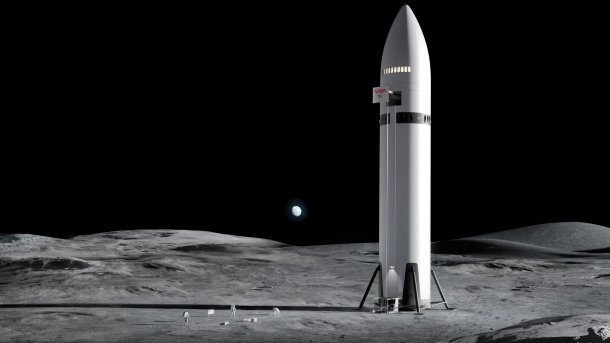
(Image: SpaceX)
The USA originally wanted to bring astronauts back to the moon in 2024, more than 50 years after the last human set foot on Earth's natural satellite. This schedule had already been described as too ambitious years ago and could not be met. Now, SpaceX, the space company commissioned by NASA for the crewed moon landing, has introduced a “simplified mission architecture” to avoid further delays.
Just under two weeks ago, the current NASA chief threatened SpaceX with contract termination for the crewed moon landing because Elon Musk's space company was behind schedule in its preparations for humanity's return to the moon. According to Sean Duffy, the USA wants to return to the moon during the current term of US President Donald Trump, which lasts until early 2029, and is in a race with China. At the same time, Duffy has now also officially admitted that the crewed moon landing will not happen in 2027. The target is now 2028. To this end, the companies commissioned with the mission were supposed to provide corresponding assurances by last week.
NASA had already decided in April 2021 that SpaceX should build the moonlander for the Artemis mission in 2024 to land humans on the moon that year. However, there are delays in the development of the Human Landing System (HLS) and the necessary spacesuits. The HLS is intended to transport astronauts from lunar orbit to the lunar surface and back. The system design provides for SpaceX to place a refueling station in Earth orbit. The HLS must refuel with propellant and oxygen there before it departs for the moon. However, this very refueling process is anything but trivial, so that NASA safety experts doubted the moon landing in 2027 had.
Simplification of the moon mission without details
Now, in a comprehensive statement, SpaceX has hinted at a new approach to bring astronauts to the lunar surface faster than the previous plans for the Artemis 3 mission envisioned. However, Musk's space company is not providing any details. “In response to recent requests, we have presented and are currently formally reviewing a simplified mission architecture and operational concept,” SpaceX said. “We are confident that this will enable a faster return to the moon while improving crew safety.”
Videos by heise
However, SpaceX has not publicly discussed these plans so far. It remains unclear whether these are changes to Starship itself or to other mission elements such as the Orion spacecraft or the rocket, the “Space Launch System” (SLS). However, the company emphasizes the path to the moon taken so far: “Starship continues to be both the fastest way to return humans to the lunar surface and a central component of the Artemis program, which aims to establish a permanent and sustainable presence on the lunar surface.”
Important tests still not completed
While SpaceX points to the milestones agreed upon so far within the scope of the HLS contract, most of which were achieved ahead of schedule or on schedule. However, the space company admits that refueling in orbit is an important element of this mission that has not yet been tested. “The next important milestones in flight operations, specifically related to HLS, will be a long-duration flight test and the in-space propellant transfer flight test,” SpaceX said.

These tests require placing a starship in orbit for an extended period to check the systems. Afterward, a second Starship is supposed to dock to refuel. The space company even names a schedule: “The exact timing depends on the progress of the upcoming flight tests, which will introduce the new Starship V3 architecture, but both tests are scheduled to take place in 2026,” says SpaceX.


(fds)

