


Telekom data center with 10,000 Nvidia GPUs being built in Munich
In partnership with Nvidia, Telekom is building an AI data center in Munich and wants to "test the waters" with it. The services will run under the German flag.
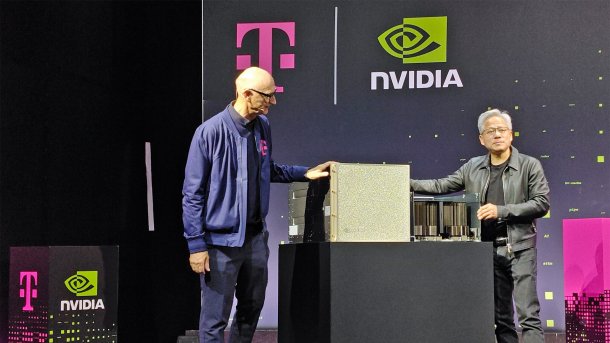
Dancing around the golden box: The two CEOs Tim Höttges and Jensen Huang in Berlin.
(Image: Falk Steiner)
Telekom CEO Timotheus Höttges stands visibly proud on the stage of the former gasometer in Berlin-Schöneberg, next to him a GPU cluster of the current Blackwell generation and Nvidia founder Jensen Huang. He has come to Berlin to present the "Industrial AI Cloud" with Telekom and numerous prominent figures from politics and business.
It will run in a new AI data center in Munich, equipped by Nvidia and connected and operated by Deutsche Telekom. 10,000 Blackwell GPUs are to be housed in the underground levels of a former bank building in the Bavarian state capital. The plans have been underway since Pentecost, the data center is scheduled to start operations in January.
The data center, which costs one billion euros and houses 10,000 GPUs, is rather small compared to Microsoft's plans in the US state of Wisconsin. It will be connected via T-Cloud and also utilized with simple services for smaller companies and users with AI needs. This is not a huge sum given the dimensions at Nvidia and Telekom, Huang emphasizes. But, and this is what everyone in Berlin emphasized at noon on Tuesday: It is intended to be a starting point and a signal.
Höttges: AI or bust
"Without AI, you can forget German industry," says Höttges. Huang would not put it so drastically; he refers to the development of "Industry 4.0" and beyond. But with "industrial AI," there will be a tremendous boost again, says Jensen Huang. It's about truly bringing AI and companies together now, says Huang, whose company has been working closely with the automotive industry in Germany for years, among other things.
"Germany can do AI if we want to," says the Federal Minister for Research, Technology and Space (FTR), Dorothee Bär (CSU), and speaks of an important step forward. "Is that enough? Of course not." But at least a first step has now been taken. Eulogies on Germany's capabilities are premature, as a lot is already happening in the country.
Progress as a fundamental right
Federal Digital Minister Karsten Wildberger (CDU) hopes for the much-needed breakthrough from the project. "AI is less a technical capability: it is a fundamental strategic key competence," says Wildberger. "And for Germany and Europe, the decision must be clear: not to be spectators, but to help shape it." Especially with AI regulation and data protection, the continent must move forward: "Europe must manage risks, but not slow down progress," demands Wildberger. "Privacy is a fundamental right, but so is progress."

Are Germany and its users ready for this progress – and willing to pay for it? It's about "testing the waters," says Höttges, whether Telekom can compete in the market for AI data centers and services. The offering from Telekom and Nvidia is particularly aimed at those who value digital sovereignty. According to Telekom, the services are operated at all levels in Germany and are subject exclusively to German jurisdiction.
Videos by heise
SAP services to simplify integration
An important part of users is to be won over through SAP's involvement in the project. "Everything runs on SAP," jokes Huang, as its CEO Christian Klein is about to explain his part. The SAP board does not contradict this, and that is intended to be one of the strengths of the Munich AI application: SAP is already there and offers the possibility of platform usage in the AI data center – for large, medium, and small companies, and of course the state: Whether the bet pays off remains to be seen. If the Munich adventure is successful, and the chances don't seem bad, larger projects are likely to follow.
Huang emphasizes that Nvidia is ready for further investments in Germany. "Foreign investors want returns, they want security, and they want legal certainty," says Deutsche Bank CEO Christian Sewing, speaking as a representative of the "Made for Germany" business initiative. Legal certainty, in particular, is a valuable asset in these times, but the location's competitiveness is, of course, also important.


(mki)

