


RAM: Memory prices skyrocket
Fears are coming true: Selling prices for memory modules are also rising significantly in Europe. There is no end in sight as demand grows.
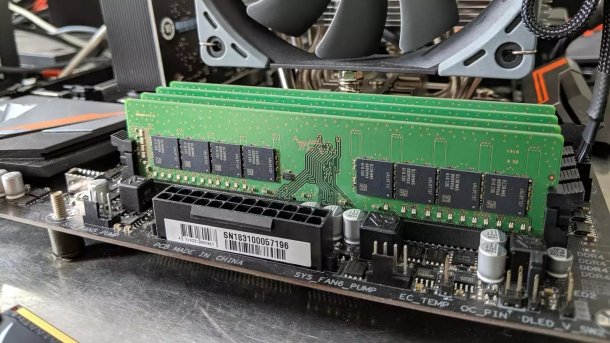
(Image: Mark Mantel/ heise medien)
In recent weeks, retail selling prices for PC memory modules have risen sharply in Europe. A 16 GByte DDR5-5600 stick currently costs at least 60 Euros; in August, they were available from 45 Euros.
The relative increase for DDR4 memory modules is even greater because their prices had fallen sharply in the meantime. A precise overview is difficult, as prices are currently also fluctuating significantly and depend on the specifications of the specific modules.
Videos by heise
Demand is growing
Market observers, such as the Taiwanese company TrendForce, had already expected the rise in RAM prices. However, prices in Europe only started to rise later compared to other markets.
Several reasons are cited for the price increase. For example, inflation, energy costs, and the generally uncertain market situation, partly due to US tariffs, play a role.
Above all, however, demand for RAM continues to grow due to the ongoing AI hype. While this is not actually about DDR4 and DDR5 SDRAM chips soldered onto standard memory modules for desktop PCs (DIMMs) and notebooks (SO-DIMMs), as AI accelerators primarily use High Bandwidth Memory (HBM) or graphics memory like GDDR6/GDDR7. However, some AI servers also accommodate large quantities of the Low-Power (LP) DDR SDRAM chips, originally developed for smartphones and notebooks, currently primarily LPDDR5X.
But because demand for LPDDR5X and HBM3/HBM4 is so high, the three market-dominant DRAM companies Samsung, SK Hynix, and Micron have converted many production lines for them.
At the same time, the end of Windows 10 support is also increasing demand for ordinary DDR5 SDRAM for desktop PCs and mini-PCs, as well as for LPDDR5X for thin notebooks.
Predicted Development
As early as August, significantly rising prices for DDR4 SDRAM were becoming apparent. And Raspberry Pi Ltd. charged more for its single-board computers also increased because LPDDR4 chips became pricier.
Market observers do not expect the situation to improve, at least as long as the AI boom continues.
For SSDs for desktop PCs and notebooks – M.2 SSDs with PCIe 4.0 x4 and SATA SSDs – price increases were also predicted. However, these do not seem to have fully translated to European retail sales so far.
No significant price increase is visible for SD and microSD memory cards or USB sticks either.
Some high-capacity hard drives for servers have become pricier in recent weeks. Here too, demand is increasing due to the AI boom. Large quantity orders are reportedly only fulfilled with long delivery times.
Empfohlener redaktioneller Inhalt
Mit Ihrer Zustimmung wird hier ein externer Preisvergleich (heise Preisvergleich) geladen.
Ich bin damit einverstanden, dass mir externe Inhalte angezeigt werden. Damit können personenbezogene Daten an Drittplattformen (heise Preisvergleich) übermittelt werden. Mehr dazu in unserer Datenschutzerklärung.


(ciw)


