


Bundestag: Police May Hunt ATM Burglars with State Trojans
The members of parliament have passed a law on explosive hazards. Law enforcement officials are now allowed to carry out source-based TKÜ for ATM explosions.
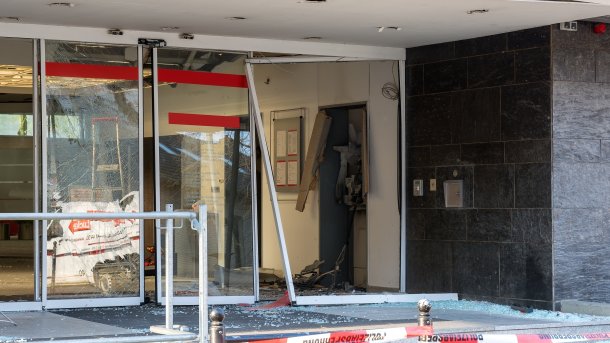
(Image: Lilia Solonari/Shutterstock.com)
Police will in future be able to hunt ATM burglars using state trojans (Staatstrojaner). On Wednesday, the Bundestag passed a bill from the federal government "on more effective prosecution and combating of criminal offenses related to explosive substances" unchanged with the votes of the CDU/CSU, SPD, and AfD. The Greens voted against it, and the Left abstained.
According to the initiative, law enforcement officials will be able to read encrypted messages exchanged via messengers like WhatsApp, Signal, or Threema in the fight against ATM explosions. In addition, the members of parliament have criminalized attempted unlawful acquisition or offering of explosive substances.
To effectively combat organized explosive crime, a qualification offense will also be created in the Explosives Act "for gang-related and commercial offenses." This will carry a prison sentence of six months to five years. At the same time, such offenses are to be included in the already broadly defined catalog of Paragraph 100a of the Code of Criminal Procedure (StPO). This originally regulated the tapping of classic telephone calls or access to emails. Since 2017, however, investigators have also been allowed to spy on encrypted internet calls and chats in numerous cases encrypted internet calls and chats.
Source-TKÜ Against Criminal Structures
At the time, the legislator created a legal basis for source-based telecommunications surveillance (Quellen-TKÜ). This involves intercepting ongoing communication directly on a suspect's end device before it is encrypted or after it is decrypted. The Federal Constitutional Court ruled in August: Police may no longer use state trojans if the pursued offense is punishable by a maximum prison sentence of three years or less. So-called "everyday crime" is to be excluded.
Videos by heise
However, with the resolution of the bill, ATM explosions can in future be punished with prison sentences of at least two years, and under certain circumstances, such as life-threatening endangerment of third parties, even from five to 15 years. Currently, the minimum sentence is still one year. The new requirements of the Karlsruhe judges for Quellen-TKÜ therefore do not apply here.
The investigation of this type of organized explosive crime, particularly in connection with ATM explosions, is often hopeless or significantly more difficult without telecommunications surveillance, the federal government explains its approach. Criminal gangs predominantly use telecommunications media for planning, procurement, and execution of offenses, typically across borders and conspiratorially. Only TKÜ makes it possible to trace the division of labor and communication channels of the perpetrators and to identify the masterminds.
In the final debate, Marc Henrichmann (CDU) referred to the "truly worrying increase in the number of ATM explosions" since 2021. This had caused total damage in the clear three-digit million range and impaired "people's sense of security." Helge Lindh (SPD) emphasized that these are not just property offenses: "It is fundamentally and concretely about the safety of people." He highlighted the dangerous nature of the acts, which also endanger "people in the vicinity" and emergency personnel.
Criticism of Symbolic Politics
For the Greens, Marcel Emmerich criticized the draft as "a piece of symbolic politics without real security gains." The current decline in explosions is due to the banks' upgrades and "strong investigative successes – especially through international cooperation, particularly with the Netherlands." Criminals are deterred "when they are caught quickly," but not by higher penalties. Emmerich instead called for "stricter explosives law" to make access to dangerous substances more difficult, as well as more controls.
Katrin Fey of the Left accused the federal government of "reactively resorting to tougher criminal laws" and using the opportunity "to further expand the powers for telecommunications surveillance." She fears a constant increase in catalog offenses that "enable secret infringements of fundamental rights."
The bill, which ultimately builds on a proposal by the traffic light government, is based on the figures for 2022. At that time, the caused and completed explosions of ATMs reached their previous peak with 496 cases. In 2024, there was a decrease to 269 explosions, with loot damage of 13.4 million euros. However, not only AfD parliamentarians saw no reason to sound the all-clear in the declining trend.


(nie)


