


Electrostatic Defrosting: Researchers Remove Frost Without Heat and Chemistry
To defrost surfaces, heat or chemicals are usually used. A new method relies on electrostatics instead.
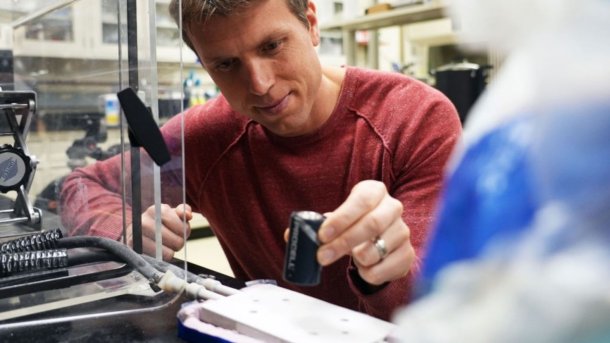
Research lead Jonathan Boreyko during experiments on a frost layer.
(Image: Virginia Tech/Alex Parrish)
A research team from Virginia Tech has developed initial approaches to remove frost without using energy-intensive heat or expensive and environmentally harmful chemicals. The process, called Electrostatic Defrosting (EDF), requires little energy but can only achieve 75 percent defrosting of a special surface at an early stage of development.
Research lead Jonathan Boreyko declared war on frost a long time ago. In 2021, he had already developed a method that can detach microscopic ice crystals from a surface using an applied electric field. Now, Boreyko and his team have expanded this concept to enable more effective defrosting without heat or chemicals. Both methods are harmful to the environment, due to high energy consumption on the one hand and the use of environmentally damaging chemicals on the other. The newly developed process is called by the Wissenschaftler">researchers Electrostatic Defrosting. They described it in the study with the simple title "Electrostatic Defrosting"">"Electrostatic Defrosting", which was published in Small Methods.
Defrosting through electrostatic process
EDF works by targeting the physical properties of ice. During the formation of ice crystals, water molecules arrange themselves into an ice crystal lattice. However, disturbances can occur, such as the absence or addition of a hydrogen ion. These tiny disturbances are called ionic defects, which exhibit local positive or negative charge imbalances.
In the EDF method, a positive voltage is now applied above the iced surface to a copper electrode, which attracts the negative ionic defects, which then move to the top of the frost layer. The positive ionic defects, on the other hand, are repelled and migrate towards the base. This strongly polarizes the frost. This exerts such a strong attractive force that frost crystals break out and jump towards the electrode.
Even without an applied voltage, the electrode removed about 15 percent of the ice due to self-polarization. With an applied voltage of 120 volts, 40 percent of the frost was removed, and at 550 volts, it was 50 percent. However, the assumption that a higher voltage would lead to better defrosting did not initially hold true. On the contrary: at 1000 volts, only 30 percent of the frost detached, and at 5500 volts, only 20 percent.
Videos by heise
The researchers found that at high applied voltages, charge leakage occurred from the polarized frost into the underlying substrate. Therefore, the researchers used an air-retaining, extremely hydrophobic substrate. This resulted in up to 75 percent of the frost being removed at higher voltages.
The scientists currently consider EDF to be in a "very early stage." They intend to intensify their research to remove 100 percent of the frost. This also includes investigations into how frost can be removed from various surfaces, not just a specific one.



(olb)

