


With Nighthawk Chip, IBM Aims for Quantum Supremacy by 2026
IBM unveils new quantum chip architecture, aiming to lay foundation for valuable quantum computer applications within four years.
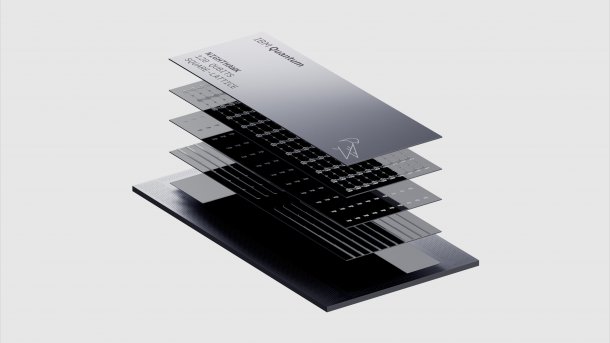
The new Nighthawk quantum chip currently comprises 120 qubits. The new chip architecture allows for a particularly high number of cross-connections and gate operations with annually increasing qubit counts.
(Image: IBM)
At its annual Quantum Developer Conference in Atlanta, IBM today presented its quantum computing roadmap. By the end of 2026, the company plans to demonstrate the superiority of its quantum computers over classical computing technology. By 2029, fault-tolerant IBM quantum chips are expected to be possible, a crucial prerequisite for the use of economic applications on quantum computers.
"We believe we are the only company that can develop and roll out both the design and manufacturing of quantum computer hardware, as well as the associated software and error correction," says IBM Research Director Jay Gambetta. He introduced the Quantum Nighthawk, with 120 qubits and a new architecture, as the most advanced quantum processor to date. Based on this and with powerful quantum software, IBM aims to prove quantum supremacy next year. To achieve this, they plan to present an application by then that can be calculated faster on the Quantum Nighthawk than with any other classical method, including supercomputers.
Videos by heise
On the Nighthawk processor, each qubit is connected to each of its four neighbors in a square grid. The increased connectivity compared to previous chips is intended to enable more computationally intensive algorithms on the chip, with up to 5,000 two-qubit gates, the entanglement operations crucial for quantum computing. According to the current IBM roadmap, future developments of the Nighthawk should support up to 7,500 two-qubit gates by the end of 2026. By 2028, this chip architecture should map at least 1,000 qubits to up to 15,000 two-qubit gates. So-called long-range couplers, which have already been demonstrated on experimental processors, are then intended to enable even more connections between qubits.

(Image: IBM)
In parallel, IBM is developing an experimental processor that includes all components for fault-tolerant quantum computing. Under the designation Loon, a new architecture is being created on which the company intends to implement all components developed today for efficient quantum error correction in a scalable manner. Furthermore, new routing layers are intended to realize additional long-range couplers between qubits. With the Loon processor, IBM announces the first fault-tolerant quantum computer for 2029.



(agr)

