


IOEMA: Germany to be reconnected via subsea cable
A subsea cable named IOEMA is set to connect North Sea coastal states. Security and high data rates are the focus to protect digital infrastructure.
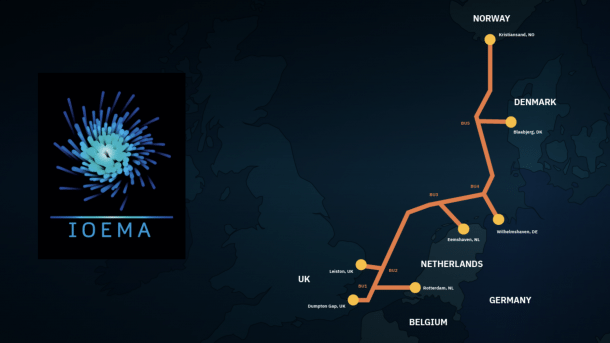
The graphic shows the planned route of the IOEMA subsea cable, which is also set to land in Germany, in Wilhelmshaven.
(Image: IOEMA)
Planning a submarine cable in 2025 is not that easy. In addition to investors and network partners for the connection, security also plays an increasingly important role in today's projects. Global connectivity has become too important to lightly accept a failure caused by a ship captain's incorrect anchor drop. And what's more: Observations of spy ships in the North Sea and North Atlantic have recently raised fears that the world's digital backbone could increasingly become a target for sabotage.
Eckhard Bruckschen knows these concerns all too well. The managing director of the project company IOEMA, based in Great Britain, is currently planning a long subsea cable that will connect the European North Sea coastal states. The fiber optic cable is also intended to land in Germany. A connection is planned in Wilhelmshaven, Lower Saxony, which Bruckschen intends to realize with the network operator EWE from Oldenburg. It would be the first internet subsea cable to land directly in Germany since the decommissioning of TAT-14 in 2020. Previous subsea cables were connected further west in Norden, East Frisia.
Cable to be buried
IOEMA is planned as a 1620-kilometer fiber optic cable to be buried at a depth of one and a half meters. In its first expansion phase, it will connect Great Britain, the Netherlands, Germany, Denmark, and Norway. The advertised name, Internet-Operator-Europe-Midwest-America, reveals it: IOEMA is intended to be nothing less than a strategic reorientation of the digital infrastructure in Northern Europe, according to a presentation of the project. Data transmission rates of up to one petabit per second are possible for this (currently planned: 24 fiber optic pairs with 37 terabits/s or more per pair).
The IOEMA system is intended to connect a total of seven landing points: in Great Britain, these are Leiston and Dumpton Gap; in the Netherlands, Eemshaven and The Hague (both new landing points); plus Wilhelmshaven in Germany, Blaabjerg in Denmark, and Kristiansand in Norway. A possible extension to Saint-Valery-en-Caux in France with an additional 210 kilometers of cable length is currently being examined.
Repeaters with multiple sensors
Security plays a major role, emphasizes the managing director of the project company: “We have to bury the cable on average 1.5 meters deep in the seabed to protect it from interference from fishing or anchors,” he explains. In coastal areas, the laying depth is even to be up to three meters. The entire system will be fully armored, and the coastal sections will even be double-armored.
Videos by heise
Such a far-reaching cable naturally also crosses other connections: over 90 crossings with existing fiber optic cables, power lines, and pipelines must be overcome. The repeater distances are between 70 and 80 kilometers, depending on the finally chosen manufacturer. Sensors that detect seismic activities, temperature changes, and movements are intended to increase the security of the cable. Their data could be used for both security and scientific purposes.
Route along the coasts
However, security also plays a role in the cable's route. The European Commission recently published a report on the security of subsea cables. A major problem identified in the study is the responsibilities far from the coasts and that cables run in corridors that cannot be constantly monitored. IOEMA is intended, instead, to run as much as possible where it is already being closely watched: “Our route runs parallel to the coastline and offers another 'border' that ships—including dark ships (ships that do not send a position signal, editor's note)—have to cross and which can then be monitored more easily,” says Bruckschen.
This unique selling proposition is also intended to make the cable attractive to investors and users. Because the realization is not yet secured. The pre-sale phase is currently underway. Only when at least 25 percent of the capacities are sold will the next step follow. And here too, the European project is moving in a difficult environment. The subsea cable market is dominated by the major US hyperscalers like Amazon and Meta, the EU noted. Bruckschen also confirms this in an interview with heise online. For the tech giants, investments in subsea cables are “pocket change.” And it's impossible without them: “Nowadays, you have to get at least one hyperscaler on board the cable system to interest the investment community.” At IOEMA, they hope that the increased interest in security will lead to the project being realized against this trend.
Further timeline
If the pre-sales proceed as planned, contracts for the installation of the cable could be concluded towards the end of the first quarter of 2026. “Then the cable system would be operational by the beginning of 2029,” according to Bruckschen's timeline. The technical specification (RFQ) is currently being prepared, and applications for the EU's Connecting Europe Facility (CEF) program have already been submitted.
IOEMA is intended to reduce latency times by up to 5.5 milliseconds on certain routes. It is also intended to provide more network redundancy in Northern Europe. It is intended to fill gaps left by the shutdown of old subsea cables. And the cable could better connect mainland Europe to Scandinavia, where more and more data centers are being built due to favorable renewable energy.


(mki)


