


ABS: Why safety technology on e-bikes is hardly used
ABS on pedelecs can reduce falls and rollovers. Solutions have existed for almost ten years, but interest is low.
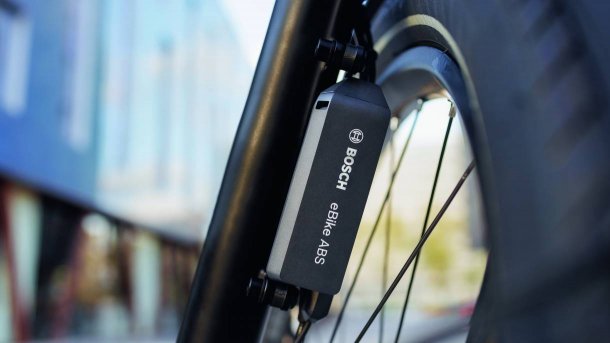
Bosch's ABS is intended to help prevent accidents caused by incorrect braking.
(Image: Bosch eBike Systems)
In July 2017, Bosch presented the world's first production-ready anti-lock braking system ABS for pedelecs at its test track in Boxberg. I was allowed to test the system at the time—and subsequently summarized in my test report: “Hopefully ABS will soon be mandatory on e-bikes too, because it makes cycling significantly safer.” But that was pure wishful thinking. Meanwhile, more and more people are dying in accidents with their electric bicycles, and very few of these vehicles are equipped with a digital braking system. What is actually slowing down ABS on pedelecs?
Are e-bike riders living dangerously?
Yes, very much so compared to other road users. According to data from the Federal Statistical Office, every sixth person (16 percent) involved in road accidents last year was on a bicycle. 441 cyclists died on Germany's roads, 192 of whom were riding a bicycle with an electric drive. The number of cyclists killed has increased by 11.4 percent in the past ten years. This increase is primarily due to the rising number of e-bike riders killed, according to the statistical office. In contrast, the number of traffic fatalities decreased by 18.3 percent in the same period. So, while the danger of dying in road accidents is noticeably decreasing for road users as a whole, it is increasing sharply for pedelec riders.
The findings of the Federal Statistical Office on accident figures for cyclists are refined by the accident research of the insurers UDV, which investigated the causes of accidents in a research project and found: “Every third cyclist who dies in an accident now has an accident completely alone, i.e., without another party involved,” says UDV head Kirstin Zeidler. This considerable proportion has increased massively in recent years. There are two main reasons for the single-accident phenomenon: accident-prone cycling infrastructure and riding style. In terms of riding style, speed and braking are the main causes of falls. This is where ABS comes into play. “As one measure among others from the research project, we recommend ABS, especially for pedelecs,” says Zeidler. The system is intended to reduce accidents.
Videos by heise
Can ABS on e-bikes save lives?
A clear yes! Up to 29 percent of all pedelec accidents could be prevented or mitigated if all e-bikes were equipped with ABS. This figure is based on studies by Bosch accident research. This is because a common cause of accidents is unsafe or hesitant braking in challenging situations, such as on wet roads, on gravel, or braking too hard when encountering sudden obstacles.

In both cases, ABS helps because the full braking power can be used without the front wheel locking, which almost inevitably leads to a fall. The ADAC concludes in an ABS test on pedelecs concludes that braking safety increases.
How does ABS work on pedelecs?
In recent years, rim brakes have increasingly been replaced by hydraulic disc brakes. Modern braking systems provide significantly more stopping power.
When hydraulic brakes are combined with an ABS system, sensors on the brake discs of both wheels measure their rotational speeds. If the front wheel locks up due to excessive braking, the control unit intervenes lightning-fast and reduces the pressure on the front wheel's hydraulic brake until it starts rolling again. Brake pressure is then reapplied. This process can repeat many times per second, allowing e-bike riders to come to a safe stop even with the brake lever fully pulled.
ABS prevents a locking front wheel. On the rear wheel, the system prevents it from lifting off the ground, thus preventing the vehicle from flipping over. This technology thus fulfills two essential safety functions.
An ABS system consists of a control unit, wheel speed, acceleration, and position sensors, as well as special braking components. The electronics require power and therefore cannot be installed on a normal bicycle. Retrofitting an e-bike is not possible because the system is deeply integrated into the drive, sensor, and braking systems and must be considered during the bike's conception.
Why are so few e-bikes equipped with ABS?
Bosch is a pioneer in ABS for e-bikes; the first version was available in 2018. According to the manufacturer, this has been significantly further developed. “Today it is 77 percent smaller, 55 percent lighter, and available in two versions,” says Tamara Winograd, Head of Marketing and Communications at eBike Systems, a business unit of Bosch. One version is for everyday use, the other for sports. In addition, the ABS modes are tailored to the respective e-bike type, for example, for touring, trail, or cargo bikes. Every new technology needs its ramp-up phase, according to Winograd.
Although the technology has significantly improved since its market launch and several manufacturers now offer corresponding systems, only a small proportion of currently available e-bikes—especially in the upper price segment—are equipped with it, according to the Zweirad-Industrie-Verband (ZIV) upon request. In addition to Bosch, the Italian company Blubrake, among others, produces ABS for pedelecs.
“Modern disc brakes are already very good and already convey a high sense of security,” says René Filippek, technical expert at the Allgemeiner Deutscher Fahrrad-Club (ADFC). For many customers, this is sufficient. “Therefore, the added value of a more expensive ABS system is not apparent to them.” ABS makes already expensive electric bicycles even pricier. The price increases by between 300 and 500 euros.
The German bicycle manufacturer Cube exclusively equips its e-bikes with Bosch ABS. “The share has increased from 2 percent last year to 10 percent in the current season,” says Marie Korzen from Cube's marketing department. The increase is due to the significantly improved availability and variety of compatible suspension forks and braking systems, meaning ABS is no longer limited to high-end products. “We firmly believe that the share will increase significantly in the future.”
Should ABS be mandatory on e-bikes?
ABS has been mandatory in new cars in Europe since 2004. For motorcycles, it has been mandatory since 2017, but not for all, only for vehicles with an engine displacement of more than 125 cm³ or an electric continuous power of more than 11 kW for electric motorcycles. There is no mandatory requirement for e-bikes.
However, it would also be advisable for small motorcycles and e-bikes, as ABS has particular relevance for single-track vehicles due to different driving dynamics compared to two-track vehicles: cars have high driving stability due to their four wheels and therefore have different braking behavior than motorcycles or bicycles. These tilt to the side without stabilization. And while cars remain fundamentally directionally stable even with locked front wheels, a locked front wheel on a two-wheeled vehicle almost always leads to a fall.
“It is undisputed that ABS can make riding safer, especially on slippery surfaces or for inexperienced cyclists,” says Pablo Ziller, spokesperson for the Zweirad-Industrie-Verband. However, a legal requirement for e-bikes to be equipped with ABS is not currently necessary. The decision for or against it should be left to manufacturers and consumers.
Zeidler from accident research at the insurers argues similarly: “Recommended, yes, but mandatory, no.”
A shame, really, because such a regulation could reduce serious injuries from severe falls and even save lives.


(dahe)

