


Digital Operating Room: How UKE is realizing the operating room of the future
University Medical Center Hamburg-Eppendorf digitizes its operating rooms using fiber optics while ensuring IT security through physical network separation.
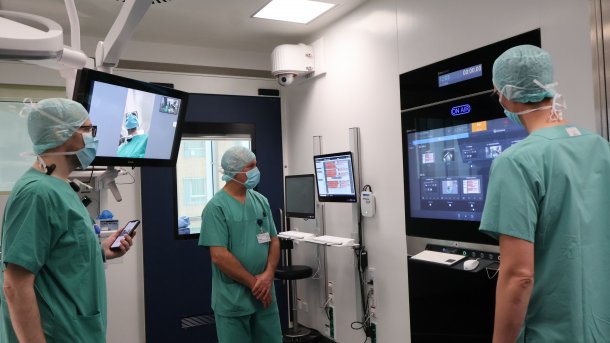
A video conference is running in an operating room at UKE. The tech team is "on air" for demonstration purposes.
(Image: Marie-Claire Koch / heise medien)
Anyone entering the operating rooms of the Martini-Klinik at the University Medical Center Hamburg-Eppendorf (Universitätsklinikum Hamburg-Eppendorf, UKE) through the sluice corridor enters a world that is reminiscent of a future laboratory, a space station, and a precision workshop. Quiet humming, sterile air, controlled movements: This is not science fiction, but modern high-performance medicine – in one of Europe's first fully digitally networked operating rooms.
Minimally Invasive – Maximally Connected
This morning, a robot-assisted prostate surgery is scheduled. The surgeon, Prof. Dr. Alexander Haese, senior physician at the Martini-Klinik at the University Medical Center Hamburg-Eppendorf, sits concentrated at the console, looking into a high-resolution 3D vision system, while four robotic arms perform millimeter-precise movements inside the patient's body. At the same time, he comments for an international audience on how he is performing the prostatectomy using the robot system. On the large monitors, every detail of the procedure appears in razor-sharp images.
Not only the surgical method is impressive, but also the invisible network in the background: a highly secure video and operating room management system that manages and distributes all image, audio, and diagnostic data of the operation in real-time.
"Previously, we had to search for the right cable and the corresponding interface for each device," explains David Rickert, IT Solution Architect Collaboration & eHealth at UKE, as he swipes across the touch display of the user interface for the video system. "Today, we connect everything via a standard plug, drag the preview image from the camera onto the screen – and the connection is live – uncompressed and without delay."
72 to 96 fiber optic cables lead from each operating room to the central technical rooms. All video, control, and communication signals converge there, far from the sensitive hygienic areas. In a glass wall on the other side of the corridor, you can see racks full of technology – quietly blinking servers that form the digital backbone of this modern surgery.
Zero Latency, Maximum Precision
The technical basis is a modular system from manufacturer Caresyntax with an AV-over-IP platform from Barco. The decision to transmit uncompressed signals over 10-Gigabit fiber optic networks was essential.
Every millisecond of delay could have fatal consequences in minimally invasive surgical procedures. Especially with imaging procedures (used in endoscopy and laparoscopy, for example), movements must be transmitted without perceptible time lag.
"If the surgeon makes a millimeter movement, the live image must be displayed in real-time," explains Rickert, pointing to the monitor that displays every camera perspective without delay.
The system can be configured flexibly: endoscopy images, MRI scans, vital signs, and patient data can be displayed simultaneously – all controllable via the uniform interface.
Videos by heise
Security Through Isolation
One of the greatest challenges in implementing the video and operating room management system lay in the conflict between cyber resilience and work practices. The system is physically disconnected from the internet, and not a single data packet can leave the particularly protected operating area. Yet, teleconsultations, teaching recordings, and live broadcasts are possible. This is made possible by hardware-based, separately operated video conferencing systems from Cisco, which only have an audio/video connection to the operating room system. When students or colleagues from other clinics are connected, it happens according to a clearly defined protocol via the internal Cisco meeting server. Accidentally starting a call is not possible. WebRTC and SIP-based connections enable live access without opening the firewall of the internal network. IT security has the highest priority at UKE. The in-house IT department's team of over 200 employees regularly revises the security concepts and has them audited repeatedly as part of the BSI IT-Grundschutz certification.

After the operation, Rickert demonstrates the video and operating room management technology in the empty room. The room's surfaces exude an almost unreal sterility, and a large-format screen is embedded in the wall. On the glass control panel, sources and destinations can be connected with a simple hand gesture: the room camera to the main monitor, patient record, or X-ray image to one of the screens above the operating table.
"The whole thing works like an interactive mixing console," he explains. "I can call up the HIS workstation, our hospital information system, display radiological findings, and start a recording if necessary – all via one interface." Several systems – the surgical devices, the HIS, the video conferencing system, the DICOM switch for importing metadata – are connected via standardized interfaces. The integration is robustly designed; even in the event of a temporary network failure, an "emergency user" can continue to work locally on the system.
Moderne Operation im UKE (15 Bilder)

Marie-Claire Koch / heise medien
)Medical technology project manager Sven Scholz was responsible for the comprehensive planning and smooth commissioning of the new equipment in the various operating rooms: "The elaborate implementation is a positive example of the excellent interdisciplinary collaboration between medical technology, IT, facility management, the operating room, and external companies."
He will also be involved when a total of 49 operating rooms throughout UKE are upgraded to the digital standard in various construction phases. The project began in 2023 with 16 rooms in the main building (O10) and will be completed by 2027. Next, the technology will be installed in the new heart center (O60) and the children's hospital (O47). The conversion is being carried out during ongoing operations – a balancing act under time pressure that requires precise coordination between the technical teams, operating room teams, and hospital hygiene. "Two operating rooms per weekend were temporarily taken out of service at times," recalls Kai Krügener, IT project manager at UKE.
The process was meticulously planned: the operating room closed on Thursday afternoon, and the construction site was scaffolded. On Friday, the construction work for the installation of fiber optic cables, control consoles, and camera systems began. Electricians and medical technicians worked in parallel, while project managers and specialist planners precisely monitored and documented the expansion. On Saturday afternoon, the cabling was commissioned, and on Sunday, error checks, cleaning, air measurements, and final hygienic acceptance were carried out.
Even the smallest work steps – sealing drill holes, adjusting the laminar air flow system, or removing dust during final cleaning – were checked multiple times. Between fiber optic laying, CE conformity of camera housings, and hospital hygiene requirements, medical technology planning, construction management, and IT project teams worked hand in hand. Only when all hygiene tests were passed were patients allowed to be operated on in the room again on Monday morning. "In the end, it was almost like open-heart surgery on the hospital," says Rickert in retrospect.
Funding and Foresight
The project was also realized thanks to funding from the Hospital Future Act (KHZG). For the ongoing operation, which is not covered by the funding and is the responsibility of IT application support and medical technology, UKE has replaced older existing systems with the new video and operating room management system. This has significantly optimized the operating room processes, noticeably improving both efficiency and functionality.
The video and operating room management system was designed to grow with future requirements and allow for expansions or modifications. If, for example, 8K resolutions become the standard in the operating room in the future, or artificial intelligence analyzes workflows and takes on further tasks, the technical basis for this is already in place.
UKE already has experience with such innovations, as the in-house IDM gGmbH has been bundling since its founding in 2024, extensive expertise from the fully digital patient record established in 2009. Among other things, powerful Large Language Models (LLMs) are trained and tested here in its own data center. A first result is Orpheus, a medical voice assistant that accurately transcribes medical jargon and contextually integrates it into documentation – thereby noticeably reducing the documentation effort for surgeons and hospital staff.
Many clinics in Germany are now recognizing the growing need for digitized operating room infrastructure. The solution integrated at UKE is meeting with great interest and increasingly serves as a blueprint for the expansion of digital operating room architectures. This shows how important networked and future-proof operating room systems have become for modern clinics.
The concept – clear network separation, standardized connections, intuitive operation, and distributed intelligence – can be transferred to new buildings and existing facilities. "At first, you think you're just installing a few monitors," says Rickert with a smile. "But in reality, you're redesigning the nervous system of the entire operating room area."
More Than High-Tech: A Cultural Shift
The most significant change is not at the operating table, but in the way of working: Where surgeons previously had to coordinate their environment themselves, smart technology now ensures that all relevant information is available at the right moment. With a few (touch) gestures, required data sources can be brought to the desired screen in seconds.
While doctors concentrate on the procedure and controlling medical devices, the video and operating room management system supports documentation, image archiving, and enables later analysis of the procedure for education and research. All of this represents a new approach to digitalization – not as an experiment, but as an integral part of clinical routine: reliable, transparent, suitable for everyday use: "The project shows that data protection and innovative spirit can go hand in hand," says Rickert. "Progress is possible without compromising security."
Extensively revised and supplemented with quotes.


(mack)

