


Analysis of the Digital Sovereignty Summit: Open Source Gets Scolded
Open-source software reduces dependencies on Big Tech – but played hardly any role at the Digital Sovereignty Summit, analyzes Christian Wölbert.
(Image: BMDS)
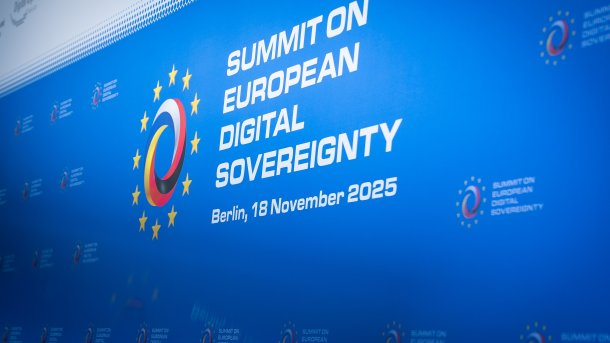
French President Emmanuel Macron, Chancellor Friedrich Merz, digital ministers from 23 EU states, plus around 1000 other participants: they all came to Berlin on Tuesday for the first “Summit on European Digital Sovereignty,” hosted by the German and French governments. A big stage for open-source software like Linux distributions, LibreOffice, Nextcloud, or Collabora—or so one might think.
After all, open-source applications can immediately and noticeably reduce dependencies on tech giants. Among others, Schleswig-Holstein or the International Criminal Court are currently demonstrating this. But in reality, open-source providers were treated shabbily by politicians at the summit, even scolded in places.
A Slap in the Face for Open Software
This is most clearly seen in the “Charter for Digital Sovereignty and Resilience,” initiated by Austria, which was signed by all EU states at the summit. The text states: “Open-source solutions can play an important role in strengthening digital sovereignty, provided they meet high cybersecurity standards and, where appropriate, are complemented by reliable proprietary technologies.” Open source is thus branded as technology that is typically insecure and unreliable. A slap in the face.

Fittingly, German Digital Minister Karsten Wildberger and the French delegation found no time to visit the open-source industry's pavilion during their tour of the summit grounds. The ministers had previously gathered so much information in the SAP and Mistral containers that only a brief handshake and a few warm words remained for the representatives of open-source companies. Time was pressing, and the delegations hurried to the press conference.
ZenDiS Dropped from the Program
At a German-French “Summit on European Digital Sovereignty,” one might also have expected the German “Center for Digital Sovereignty” (ZenDiS) to play a prominent role. After all, the federal government itself founded ZenDiS to, well, advance digital sovereignty, for example with openDesk. Moreover, the state-owned GmbH—fittingly for the summit—has long been working with French and other European partners.
According to government sources, ZenDiS was indeed included in draft programs. However, it was not mentioned in the final program, and no representative of the organization was allowed to speak on stage. While there was space for SAP, Telekom, Bitkom, the Sparkassenverband, and many others, there was none for ZenDiS.
Videos by heise
Only a few voices spoke about the advantages of open source on stage. Adriana Groh from the Sovereign Tech Agency, for example, emphasized that open source is the “winning strategy” and superior in terms of security, interoperability, and low development costs. “No silo development can keep up with this speed.”
A Little Consolation from the Chancellor
Towards the end of the event, the Federal Chancellor offered a little consolation to the open-source community. It was he who made the most concrete statements about openDesk and ZenDiS in his speech: In the next three years, they would provide “sovereign digital workplaces” in the federal administration, Merz said. Components of openDesk are used not only at the Robert Koch Institute and the Ministry of Digital Affairs but also in the Federal Chancellery.
Of course, these statements were also non-committal and essentially repeated the known plans from the Modernization Agenda. Merz by no means said that he wants to get rid of Microsoft Office and replace it with openDesk. The federal government continues to push forward with the Delos Project with SAP and Microsoft.
Overall, the impression from the summit was: In terms of digital sovereignty, politics primarily relies on “Buy European” clauses, AI and cloud projects, and on heavyweights like SAP, Schwartz Digits, or Telekom. Whether this will achieve more than, for example, Gaia-X, can only be said in a few years at the earliest. Concrete, quickly effective measures against dependencies, such as larger federal contracts for ZenDiS or projects to replace Microsoft Office with open-source applications, were not announced at the Digital Summit.
One can only speculate about the reasons. Perhaps it is the distrust of open-source software formulated in the Charter. Perhaps the change process in administration is shied away from, even though Schleswig-Holstein is demonstrating it. Perhaps, however, one simply does not want to risk provoking Trump. What is clear is that the summit was closely followed in the USA as well. In the run-up to the summit, the US Embassy, according to Politico, demanded “explanations” from the organizers.

(cwo)


