

Introducing the Porsche Cayenne Electric: A Challenge from Zuffenhausen
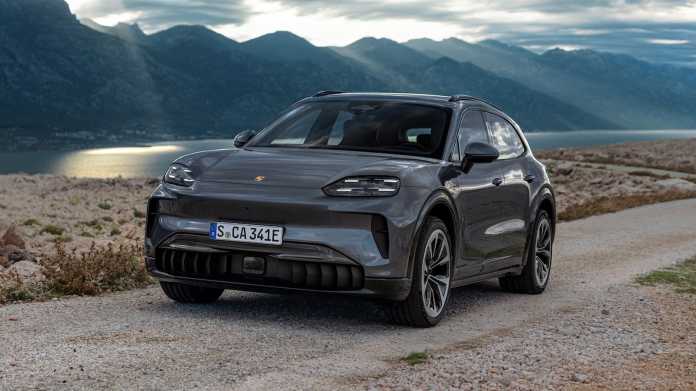
Porsche is straightening its previous course, but the new Cayenne is only coming to market as an electric car. The technical specifications are impressive.

(Image: Porsche)
Porsche cannot continue as before. Sales and profits have plummeted dramatically this year. On the other hand, many processes in the automotive industry, especially in development, are long-term and cannot be changed overnight. At Porsche, they are taking a pragmatic approach: Instead of offering only the electric version of the Cayenne after the model change, the current model with a combustion engine and hybrid will simply continue to be built.
New with electricity, continuing as before with combustion engine
This can be seen as an experience from the introduction of the Macan, which was initially intended to be launched exclusively with a battery-electric drive. A decision that Porsche has since revised, as customers did not adopt it as expected. The responsible parties did not want to create such a mess again. Yet the new Cayenne also has good qualities to convince e-mobility skeptics. It is becoming increasingly difficult to do this solely on the basis of performance, although Porsche naturally does not shy away from providing plenty of that.
Two versions
Even the base model offers a system output of 300 kW and a peak torque of 835 Nm. It accelerates from a standstill to 100 km/h in 4.8 seconds and reaches 230 km/h. The top model offers 630 kW, with a boost function for a few seconds reaching 850 kW. Such power should be enough for the standard sprint in 2.5 seconds, with a top speed of 260 km/h. While such figures may be considered grotesque by many, they are less irrelevant to the Porsche target group than the possibility of ever being able to use them in practice. All models come with all-wheel drive and adaptive air suspension.
The WLTP consumption is expected to be around 20 kWh in both cases. Up to 640 km of range is promised in the cycle, thanks to 113 kWh of energy content in the traction battery. The maximum DC charging power is 400 kW. Equipped this way, charging from 10 to 80 percent should be completed in 16 minutes. That would be around 79 kWh recharged on average at nearly 297 kW. There's no doubt that a lot has happened in this area in recent months. For example, BMW iX3 and Xpeng G6, with promised average charging powers of over 200 kW, are significantly above what was common even in the premium segment two or three years ago.
Porsche Cayenne Electric (4 Bilder)
Porsche
)Optional inductive charging
For an additional 5000 Euros, you can get an inductive charging plate for your home parking space. The car can then be charged at a standstill with up to 11 kW. BMW once offered a similar solution, but quickly removed it from their product range due to a lack of customer interest.
Compared to its predecessor, which is still offered, the Cayenne has also increased in size in some areas. It is 4.99 m long, and its wheelbase measures 3.02 m. This should be more than enough for princely interior space. The luggage capacity of 781 to 1588 liters is supplemented by a 90 liter compartment in the front. If desired, you can tow up to 3.5 tons with the trailer hitch.
Videos by heise
From 105,000 Euros
At first glance, the financial positioning of the new Cayenne is surprising. The base model at 105,200 Euros is just above the recently raised limit for tax advantage for privately used, electric company cars. This means 0.5 instead of 0.25 percent of the list price must be taxed as a monetary benefit. It is possible that Porsche will lose some sympathy in the target group with this calculation. However, the underlying idea was likely that most interested parties will invest a five-figure sum in optional extras anyway. And those who realistically consider a Cayenne will also be able to cope with the taxation of the monetary benefit of 525 to just over 600 Euros.

(Image: Porsche)
Top model costs less than plug-in hybrid
The top model of the new Cayenne, for which Porsche is asking at least 165,000 Euros, operates in different spheres. But there is also consolation here: A Cayenne Electric Turbo is over 20,000 Euros cheaper than the current Cayenne Turbo E Hybrid with nearly 544 kW of system output. Porsche offers the customer a choice, and can expect that, at least for some, even in this price range, the combination of a new model with even more power and space for less money will have a certain appeal.

(mfz)