


Chernobyl: Containment structure no longer secure after drone attack
A Russian attack damaged the containment structure in February. The extent of the damage is enormous, as is now becoming apparent.
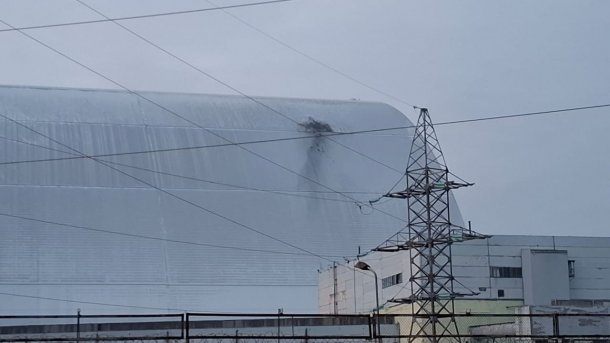
View of the impact site of the Russian drone on the containment structure of the damaged Chernobyl reactor on February 14, 2025.
(Image: Chernobyl Nuclear Power Plant)
The containment structure over the damaged Chernobyl reactor has lost its essential safety functionality. This was the conclusion reached by a delegation from the International Atomic Energy Agency (IAEA), which inspected the site of the 1986 reactor accident in Ukrainian Chernobyl.
The structure, also known as the New Safe Confinement (NSC), was only completed in 2016 to contain the radioactivity of the damaged reactor. The damage occurred during a Russian drone attack in February 2025, when a drone hit the structure and penetrated the outer protective wall of the NSC.
Parts of the aircraft also struck the inner wall, nine meters below. The incident caused a major fire, which also damaged the outer shell of the massive steel structure, as the IAEA reports. During firefighting efforts in February, additional holes had to be cut into the outer wall because the fire also raged between the two protective walls.
Fatal Damage
The delegation has now confirmed that the NSC has lost its primary safety functions, including its ability to contain radioactivity. After the drone impact in February, the IAEA had not reported any change in radiation levels, and provisional repairs prevented this from happening afterwards.
However, the extent of the damage only becomes clear when one looks at the structure more closely. After its predecessor, a concrete and steel sarcophagus built shortly after the disaster, had become dilapidated, the NSC was built and moved on rails over the old containment. The Paris cathedral Notre Dame would fit under the huge arch-shaped shell.
Decommissioning plans no longer feasible
Before the attack, there was positive pressure between the inner and outer walls of the NSC. This was intended to prevent radioactive particles from reaching the outer wall and contaminating it. This positive pressure was made possible by a plastic membrane, which was also destroyed in the fire. Repair would only be possible with the greatest effort, and the NSC would likely have to be moved for this.
Furthermore, the NSC is intended to protect the outside world if the old sarcophagus collapses entirely or partially. This is also no longer guaranteed. The decommissioning of the old sarcophagus was also supposed to take place under the NSC – this is no longer conceivable under current conditions.
Drone attack scenario not considered
In addition, the NSC was supposed to protect the outside world in the event of natural disasters and other emergencies. However, the scenario of a drone attack was not considered during development. At least the supporting structures and monitoring systems show no permanent damage, as the IAEA has now determined. However, it is doubtful whether the structure can fulfill its purpose for the planned duration of 100 years in its current state.
Videos by heise
"Limited temporary repairs have been carried out on the roof, but timely and comprehensive remediation remains essential to prevent further deterioration and ensure long-term nuclear safety," emphasizes Director General Rafael Grossi. Those responsible in Ukraine are hoping for support from a fund of the European Bank for Reconstruction and Development (EBRD). 45 donor countries had contributed around 1.6 billion euros to this fund for the construction of the NSC.



(nen)

