


"QuadStretcher":VR haptic wearable uses skin stretching instead of vibration
Researchers have presented a prototype for the forearm that simulates physical forces through skin stretching in VR applications with hand tracking.
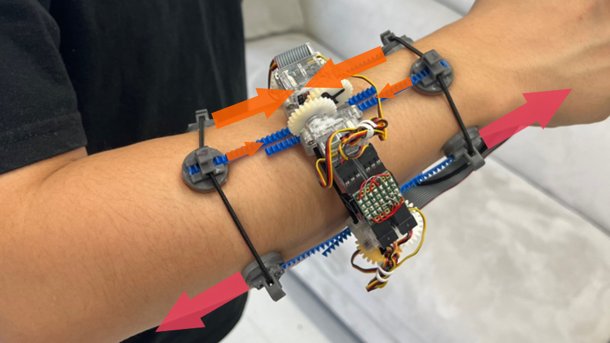
"QuadStretcher" stretches the skin for haptic feedback.
(Image: Taejun Kim)
Hand tracking is becoming increasingly precise in headsets like the Meta Quest 3, the Apple Vision Pro, or Samsung's Galaxy XR and is already partially replacing traditional VR controllers as the standard input method. However, for a truly immersive VR experience, people need to feel haptic feedback. After all, a virtual world seems significantly less believable if there is no tactile feedback when grasping virtual objects.
A research team from South Korea wants to solve this problem with a wearable. "QuadStretcher" is intended to make physical feedback in virtual reality perceptible. The special feature: it requires neither gloves nor controllers but works with targeted skin stretching on the forearm.
When a rubber band in VR suddenly offers resistance
Instead of stimulating the hand directly, the system generates a differentiated sense of force using four motorized stretching units. A stretching element is located on each side of the forearm, which pulls or pushes the skin lengthwise up to eleven millimeters via a rack-and-pinion system. The natural movement of the forearm muscles serves as a model, making the stimulation particularly intuitive.
In a study with 20 test subjects, "QuadStretcher" was compared with a Tasbi replica – a haptic armband that provides feedback through pressure pulses. The researchers evaluated the impression in six virtual scenarios, from simple gestures like pressing a button to more complex actions like stretching a rubber band or swinging a tennis racket.

While hardly any differences were perceived in simple movements, "QuadStretcher" scored points in more dynamic applications. The system performed better, especially in perceiving the direction from which the forces were acting. Many test subjects described feeling the tension when pulling a virtual band as if something was actually resisting. In comparison, the pressure from the squeezer armband felt uniform and less dependent on the situation.
Where the feedback arrives makes the difference
Another aspect: the position of the feedback influenced the experience. "QuadStretcher" is worn on the forearm, the squeezer on the wrist. For large arm movements like a tennis swing, the stretching on the forearm felt more natural. For finer hand actions, however, the pressure on the wrist was often more appropriate.
The subjective perception of how a movement should also feel played a role. Some test subjects attributed the activation of a spray bottle more to the entire arm movement, while others saw it as a simple finger action. Developers of haptic systems should therefore not only focus on technology but also on users' expectations.
Videos by heise
"QuadStretcher" is available as open source on GitHub, and follow-up projects are already in the works. In addition to a more compact design, the system will also be able to simulate impact forces in the future.


(joe)

